Aluminum gravity die casting — also called permanent mold casting — is a process where molten aluminum is poured into a reusable steel or cast iron mold. No external pressure is applied. Gravity alone pulls the metal into the cavity. The mold is preheated, coated with a release agent, and then filled from the top through a gating system. After the aluminum solidifies, the mold opens and the part comes out.
It sits between sand casting and high-pressure die casting (HPDC) in terms of cost, volume capability, and part quality. Sand casting uses disposable molds and works for prototypes or low runs. HPDC injects metal at extreme pressure for high-speed mass production. Gravity die casting gives you a reusable mold, better dimensional accuracy than sand, and better mechanical properties than HPDC — at a moderate tooling cost. For medium-volume programs of 500 to 50,000 parts per year, it often hits the sweet spot.
How the Gravity Die Casting Process Works
The process follows a straightforward cycle. Each step matters for final part quality.
Step 1: Mold Preparation
The steel mold (die) is cleaned and preheated to 200–300°C using gas burners or electric heaters. A refractory coating or die wash is sprayed on all cavity surfaces. This coating serves three functions: it prevents molten aluminum from sticking to the steel, it controls the cooling rate in different sections, and it extends mold life. Thicker coatings slow heat transfer and are applied in areas where you want the metal to stay fluid longer.
Step 2: Core Placement (If Needed)
For parts with internal channels, holes, or undercuts, sand cores are placed inside the mold before closing. These cores are made from resin-bonded sand and are destroyed during shakeout after casting. This is a key advantage of gravity casting — it can handle sand cores easily, while HPDC cannot because the high injection pressure would break them apart.
Step 3: Pouring
Molten aluminum — typically heated to 680–720°C — is poured into the mold through a gating system. Pouring can be done manually with a ladle, or through an automated tilting machine. Tilt pouring is preferred for critical parts because it reduces turbulence. Less turbulence means fewer oxide inclusions and less gas entrapment in the finished part.
Step 4: Solidification and Cooling
The aluminum fills the cavity and begins to solidify from the mold walls inward. Cooling rate is managed by adjusting die temperature, coating thickness, and sometimes water-cooling channels built into the mold. Solidification time varies from 30 seconds for small parts to several minutes for larger ones. Proper directional solidification — from thin sections to thick, toward risers — prevents shrinkage porosity.
Step 5: Ejection and Finishing
Once solidified, the mold halves separate and the casting is ejected. Gates, risers, and flash are trimmed. The part then goes through finishing steps as needed — shot blasting, machining, heat treatment, or surface coating.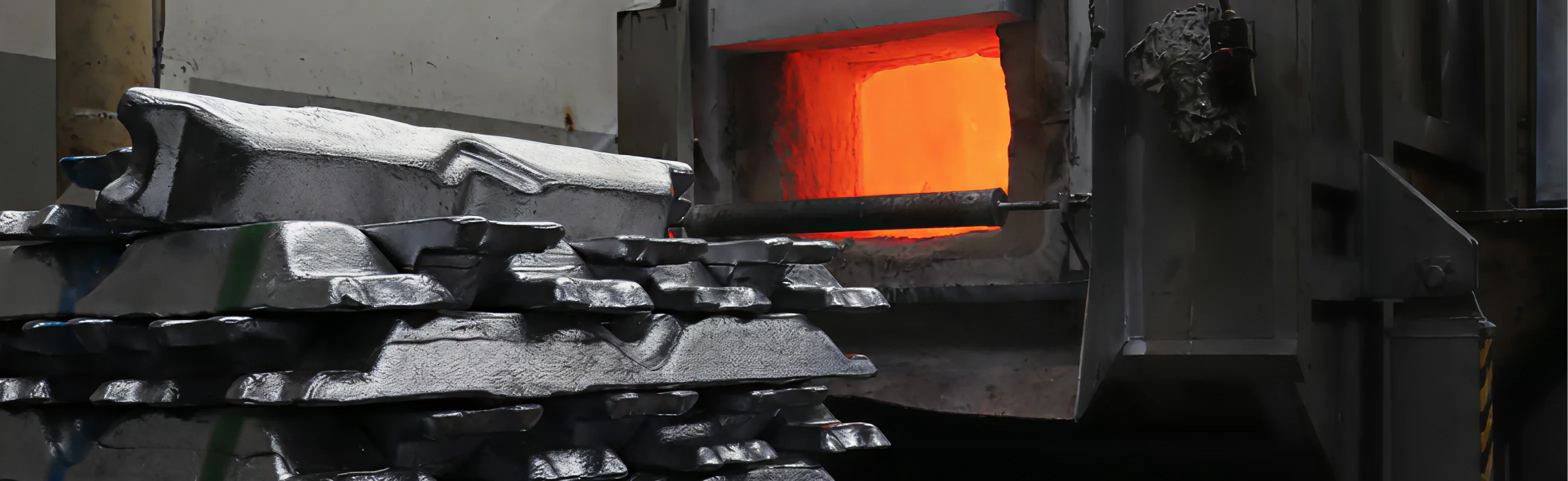
Common Alloys Used in Aluminum Gravity Die Casting
Alloy selection depends on your application requirements — strength, corrosion resistance, castability, and whether heat treatment is needed. Here are the alloys we see most often in gravity casting production:
| Alloy | Si % | Key Properties | Typical Applications |
|---|---|---|---|
| A356 (AlSi7Mg) | 6.5–7.5 | High strength after T6; excellent elongation (5–10%); good corrosion resistance | Automotive structural parts, wheels, suspension components, aerospace brackets |
| A319 (AlSi6Cu3) | 5.5–6.5 | Good strength; moderate ductility; good machinability | Engine blocks, cylinder heads, intake manifolds |
| AlSi12 (A413 / LM6) | 11–13 | Excellent fluidity; good corrosion resistance; lower strength | Marine fittings, pump housings, thin-walled covers |
| AlSi9Cu3 (ADC12 / A383) | 9.6–12 | Good all-round properties; cost-effective | General industrial parts, motor housings, valve bodies |
| A357 (AlSi7Mg0.6) | 6.5–7.5 | Higher Mg content than A356; better T6 strength | Aerospace structural castings, high-load components |
A356 is by far the most popular choice for gravity die casting. Its relatively low iron content means it does not work well in HPDC (where iron is needed to prevent die soldering), but it is ideal for permanent mold processes. After T6 heat treatment, A356 can reach tensile strengths of 260+ MPa with 5–10% elongation — a combination HPDC alloys rarely match.
Gravity Die Casting vs. High-Pressure Die Casting
This is the comparison most OEM buyers need to make. Both use reusable metal molds. Both produce aluminum parts. The differences are in the details:
| Parameter | Gravity Die Casting (GDC) | High-Pressure Die Casting (HPDC) |
|---|---|---|
| Filling method | Gravity (no external pressure) | High-pressure injection (10,000–25,000 psi) |
| Cycle time | 2–5 minutes | 15–90 seconds |
| Min. wall thickness | 3–5 mm | 0.5–2 mm |
| Typical tolerances | ±0.3 to ±0.5 mm | ±0.1 to ±0.3 mm |
| Internal porosity | Low (good for pressure-tight parts) | Higher (gas porosity from turbulent fill) |
| Heat treatable | Yes (T4, T5, T6) | Generally no (porosity expands during heating) |
| Sand cores | Yes (complex internal geometry possible) | No (cores destroyed by injection pressure) |
| Tooling cost | $10,000–$90,000 | $60,000–$500,000+ |
| Ideal volume | 500–50,000 pcs/year | 10,000–1,000,000+ pcs/year |
| Weldability | Good | Poor (porosity causes weld defects) |
| Mechanical strength | Higher elongation and fatigue resistance | Higher raw tensile strength, lower ductility |
The short version: if your part needs to be heat treated, welded, or hold pressure — gravity casting is likely the right call. If you need thin walls, tight tolerances, and volumes above 50,000 units per year, HPDC makes more sense.
Advantages of Aluminum Gravity Die Casting
Low porosity and dense microstructure. Gravity filling creates a smooth, laminar flow. Less turbulence means fewer trapped gas pockets. The result is a denser casting with better mechanical integrity. This matters for pressure-containing parts like valve bodies, pump housings, and hydraulic manifolds.
Heat treatable. Because porosity is low, gravity castings can be heat treated (T4, T5, T6, T7) without the risk of blistering that plagues HPDC parts. T6 treatment on A356 nearly doubles yield strength.
Weldable. The low gas content makes gravity-cast parts suitable for welding and brazing. This is critical for structural assemblies in automotive and aerospace applications.
Sand core compatibility. Need internal passages, hollow sections, or undercuts? Sand cores handle that. This gives gravity casting design flexibility that HPDC cannot offer.
Lower tooling investment. A gravity die costs a fraction of an HPDC die. For programs under 50,000 parts per year, this often makes the total cost per part competitive or lower than HPDC.
Good surface finish. Surface roughness typically falls in the Ra 3.2–6.3 μm range — better than sand casting (Ra 12–25 μm) and suitable for most functional surfaces without extra finishing.
Reusable molds. A well-maintained steel die can last 30,000–100,000+ cycles, depending on alloy and part complexity. That durability keeps per-part tooling costs low over the life of a program.
Limitations to Consider
Slower cycle times. A gravity casting cycle runs 2–5 minutes, compared to under 90 seconds for HPDC. This limits throughput for very high volume programs.
Minimum wall thickness. Practical minimum is around 3–5 mm. If your design calls for walls under 2 mm, HPDC is the better process.
Less geometric complexity than HPDC. Without injection pressure, the metal has less ability to fill extremely intricate or thin features. Complex ribs, bosses, and snap-fit details are easier to achieve with HPDC.
Higher per-part cost at very high volumes. Once production exceeds 50,000 units per year, HPDC's faster cycle time usually drives the per-piece cost below gravity casting.
Design Guidelines for Gravity Die Cast Parts
Getting the best results from gravity casting starts at the design stage. Here are the key rules our engineering team follows:
Uniform wall thickness. Keep walls as consistent as possible, ideally between 4–12 mm. Variations in thickness cause uneven solidification, which leads to shrinkage porosity and warping.
Draft angles. Apply 2–3° draft on external surfaces and 3–5° on internal surfaces. This allows clean ejection without damaging the part or the mold.
Generous fillet radii. Sharp internal corners concentrate stress and create hot spots during solidification. Use a minimum fillet radius of 3 mm at inside corners.
Gating and riser placement. Metal should enter the cavity smoothly and solidify directionally toward risers. Your foundry's casting simulation (MAGMASOFT, ProCAST, etc.) should validate the gating design before mold cutting.
Coring strategy. Sand cores add cost and cycle time. Use them when the geometry truly demands it, and design core prints with enough support surface to prevent core shift.
Machining allowances. Add 1.5–3 mm stock on surfaces requiring tight dimensional control or fine finish. Gravity casting tolerances of ±0.3–0.5 mm are good, but post-machining gets you to ±0.05 mm when needed.
Typical Applications
Gravity die casting serves a wide range of industrial applications where mechanical performance, pressure tightness, and moderate production volumes align. Common examples include:
Automotive: cylinder heads, intake manifolds, turbo housings, suspension brackets, transmission housings, EV battery enclosures, structural nodes.
Industrial equipment: pump housings, valve bodies, compressor covers, gearbox cases, motor housings, hydraulic manifold blocks.
Aerospace: structural brackets, actuator housings, avionics enclosures, fuel system components (where weldability and T6 treatment are required).
Electrical / HVAC: junction boxes, heat sinks, fan housings, inverter cases, LED lighting housings.
Marine: propeller housings, deck fittings, engine mounting brackets, through-hull fittings (corrosion resistance is critical here).
How to Choose the Right Casting Process
Making the right process selection depends on your specific project parameters. Use this quick decision framework:
Choose gravity die casting when: your annual volume is under 50,000 pieces; wall thickness is 3 mm or above; the part needs heat treatment (T6) for strength; pressure tightness or weldability is required; sand cores are needed for internal channels; or your tooling budget is limited.
Choose high-pressure die casting when: annual volume exceeds 50,000 units; walls are thinner than 3 mm; tight dimensional tolerances (±0.1 mm) are critical; and post-casting heat treatment is not required.
Choose sand casting when: you need only a few dozen to a few hundred parts; the part is very large (over 50 kg); or you are in the prototype stage and want to test form and fit before committing to permanent tooling.
Work With an Experienced Gravity Casting Partner
Getting consistent quality from gravity die casting depends on process control — melt temperature, die temperature, coating application, pouring speed, and cooling management all have to be dialed in. An experienced foundry doesn't just pour metal into a mold. They run casting simulations during tooling design, monitor every variable during production, and inspect castings with X-ray, CMM, and pressure testing to catch defects before parts ship.
At Meituo, we operate permanent mold casting lines alongside our high-pressure die casting cells. We work with OEM buyers across home appliance, motor, automotive, and industrial equipment sectors. If you need aluminum gravity die cast parts with consistent quality and competitive lead times, reach out to our engineering team for a DFM review and quote.