Lost foam casting is a process where a foam pattern — typically expanded polystyrene (EPS) — is packed in loose, unbonded sand. When molten aluminum is poured in, the foam vaporizes and the metal fills the cavity left behind. There's no mold to remove, no parting line, and no cores needed for most internal features.
It's a well-established industrial process used for complex aluminum components, and it's also popular among hobbyists casting aluminum at home using foam and a backyard furnace. Understanding both versions — and where the process fits versus alternatives like sand casting or investment casting — helps you make better sourcing and design decisions.
What Is Lost Foam Casting?
Lost foam casting (LFC) is classified as an expendable pattern casting process. The foam pattern is consumed during casting — hence "lost." It belongs to the same family as investment casting (lost wax), but uses polystyrene foam instead of wax and loose sand instead of a ceramic shell.
The American Foundry Society and industry sources define lost foam casting as a process that produces near-net-shape castings with no draft angle requirement, no parting line, and no flash. Dimensional tolerance for aluminum lost foam castings typically runs ±0.1–0.3 mm depending on part geometry and size, which is competitive with investment casting for many applications.
Industrial lost foam casting for aluminum is well-established in automotive manufacturing. GM used it extensively for aluminum engine blocks and cylinder heads in the 1990s and 2000s. Ford, Fiat, and several European OEMs have run large-volume aluminum lost foam programs for intake manifolds, engine blocks, and structural brackets.
How the Process Works: Step by Step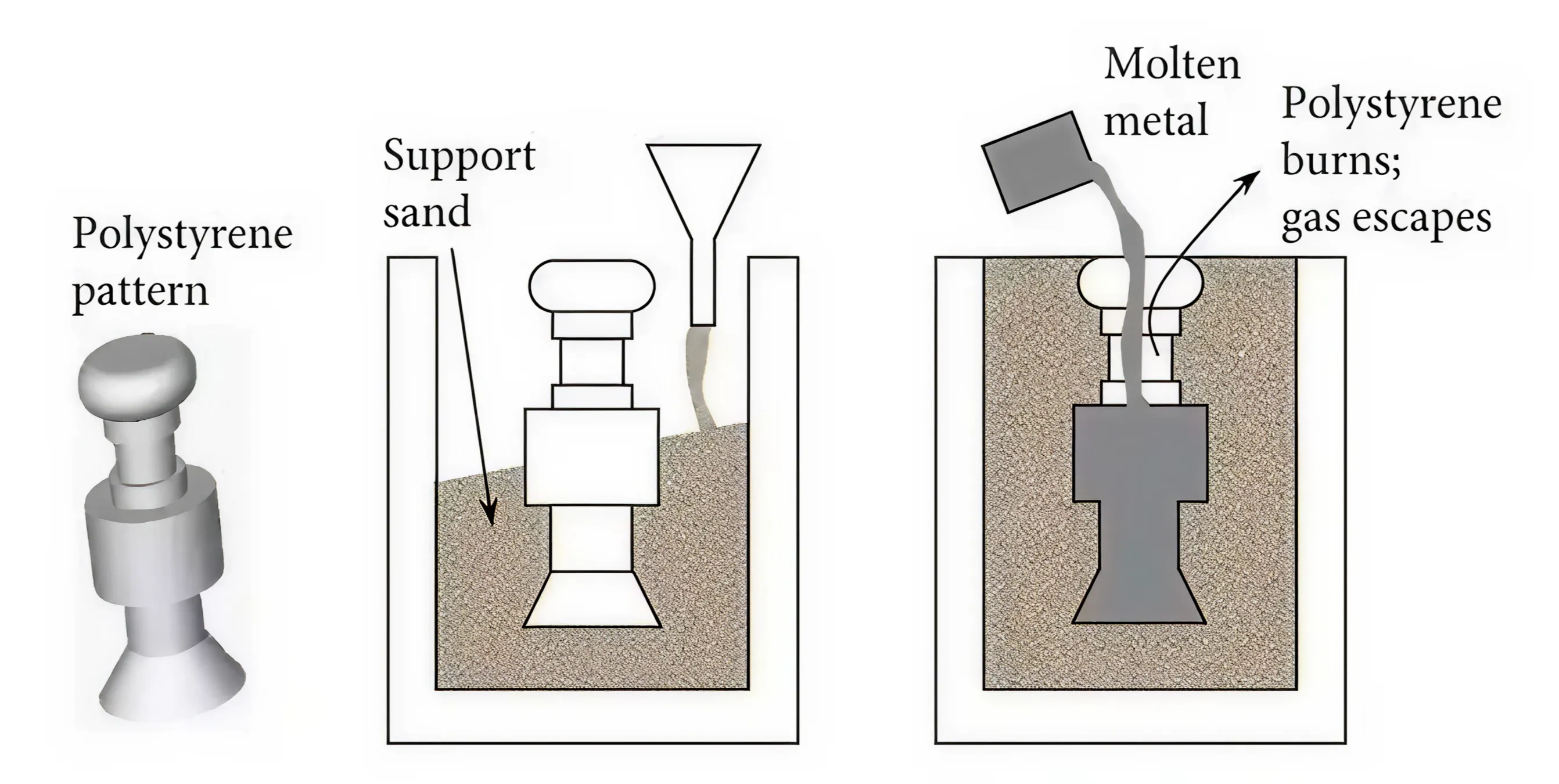
- Pattern fabrication. An EPS (expanded polystyrene) foam pattern is produced by injecting polystyrene beads into a metal die and steam-fusing them into the final shape. For prototype or low-volume work, patterns can also be cut from foam blocks using CNC machining, hot wire cutting, or 3D printing in PLA or other sacrificial materials.
- Cluster assembly. For production runs, multiple patterns are glued to a common gating system (sprue and runners) made from the same foam. A single cluster can hold 5–20 individual patterns depending on part size. This is analogous to the wax tree in investment casting.
- Refractory coating. The foam cluster is dipped or brushed with a water-based refractory slurry — a coating of fine ceramic particles (silica, alumina, zirconia, or mullite) mixed with binding agents. This coating does two things: it provides a smooth casting surface and it controls how quickly gas from the decomposing foam escapes through the sand. Coating thickness and permeability are critical process variables.
- Sand compaction. The coated cluster is placed in a steel flask. Loose, dry, unbonded silica sand is poured around it and compacted by vibration on a vibration table. No binders are used — the sand's job is to support the foam pattern and allow gas to escape. Sand density typically reaches 85–90% relative compaction.
- Pouring. Molten aluminum (typically 720–760°C for common alloys) is poured into the foam sprue. As the metal contacts the foam, the polystyrene vaporizes — the front of the molten metal and the foam pattern are always in direct contact, separated only by a thin layer of decomposition products. The metal fills the cavity as the foam retreats. Pouring rate is important: too fast and decomposition products are trapped; too slow and the metal front cools prematurely.
- Solidification and shakeout. After the metal solidifies, the flask is inverted and the loose sand falls away. The casting is extracted, the gating system is cut off, and the casting is cleaned. The unbonded sand can be recycled directly with minimal processing — a significant advantage over bonded sand systems.
Lost Foam vs. Sand Casting vs. Investment Casting
| Lost Foam (LFC) | Sand Casting | Investment Casting | |
|---|---|---|---|
| Pattern material | EPS foam (expendable) | Wood, metal, plastic (reusable) | Wax (expendable) |
| Mold material | Loose unbonded sand | Bonded sand (green or no-bake) | Ceramic shell |
| Draft angle required | None | 1–3° minimum | Minimal (0.5–1°) |
| Parting line | None | Yes | Minimal |
| Cores for internal features | Usually not needed | Required for most internal features | Not needed |
| Dimensional tolerance | ±0.1–0.3 mm | ±0.5–1.5 mm | ±0.1–0.3 mm |
| Surface finish (Ra) | 6.3–12.5 μm | 12.5–25 μm | 1.6–3.2 μm |
| Max part size | Very large (>2 m, >5,000 kg) | Very large | Small–medium (<500 kg typical) |
| Tooling cost | Medium (foam die) | Low (sand pattern) | High (wax die + ceramic shell) |
| Per-part cost (volume) | Medium–low at volume | Medium | Higher |
| Best volume range | Medium–high (1,000–100,000+) | Low–medium | Low–medium |
| Sand recycling | Easy (unbonded) | More complex (bonded) | N/A (ceramic shell) |
| Internal channels | Possible without cores | Requires cores | Possible without cores |
The key positioning of lost foam: it sits between sand casting (lower precision, simpler tooling) and investment casting (higher precision, more expensive tooling). For large, complex aluminum parts at medium-to-high volumes, lost foam often delivers near-net-shape parts at lower total cost than sand casting (less machining) with less tooling investment than investment casting.
Advantages of Lost Foam Aluminum Casting
- No draft angles required. Vertical walls, undercuts, and complex internal passages can be cast without draft because the foam is consumed, not pulled from a mold. This opens up geometries that would require expensive coring or machining in sand casting.
- No parting line or flash. There is no split mold, so there is no parting line seam and no flash to trim. This eliminates a trimming operation and avoids the dimensional variation associated with mold shift.
- Near-net shape with complex geometry. Internal channels, blind holes, and complex external profiles are cast in a single piece. An automotive intake manifold that would require multiple cores in sand casting can be a single foam pattern in lost foam.
- Simple sand system. Unbonded dry sand requires less processing than green sand or no-bake sand systems. No binders to control, no sand conditioning, lower operational complexity.
- High sand reclamation rate. Over 95% of the unbonded sand can be reclaimed and reused with minimal processing. Green sand and no-bake systems require more intensive reclamation chemistry.
- Dimensional consistency. Tolerance of ±0.1–0.3 mm is achievable and maintained over production runs because the pattern (the foam die) is dimensionally stable and repeatable.
- Reduced machining. Near-net-shape output means machining is limited to functional surfaces. One study from Modern Casting reported that compared to equivalent sand castings requiring machining, lost foam castings achieved up to 30% reduction in total processing cost when machining savings were included.
Limitations and Defect Risks
Lost foam casting has specific defect modes that don't exist in sand or investment casting. Understanding them is essential for anyone specifying or sourcing lost foam aluminum parts.
Gas Porosity
As the foam vaporizes, it produces a mix of gas and liquid decomposition products (styrene monomer, liquid oligomers, carbon residues). If these products are not expelled through the coating and into the sand quickly enough, they become trapped in the solidifying metal as porosity. Coating permeability is the primary control variable — coatings that are too dense trap gas; coatings that are too porous allow metal penetration into the sand.
Carbon Inclusions and Folds
Liquid styrene decomposition products caught between the advancing metal front and the coating produce "fold defects" — thin, planar inclusions in the casting that appear as dark lines or laminations. These are distinct from porosity and are more common at lower pouring temperatures or with slower fill rates. They tend to concentrate on upper surfaces of horizontal sections where rising gas is trapped below a solidifying metal skin.
Shrinkage Porosity
Lost foam castings solidify slowly — the foam and unbonded sand have low thermal conductivity compared to metal molds or bonded sand. Slow solidification creates shallow thermal gradients, which makes directional solidification harder to achieve and increases shrinkage porosity risk, particularly in thick sections.
Surface Roughness
Lost foam produces a rougher surface than investment casting (Ra 6.3–12.5 μm vs Ra 1.6–3.2 μm). For applications requiring smooth surfaces — sealing faces, bearing surfaces, fluid-contact passages — post-cast machining is still required.
Pattern Cost and Lead Time
A production EPS foam die is machined from aluminum or steel and costs $5,000–$30,000 depending on complexity, similar to a permanent mold pattern. This is lower than HPDC tooling but higher than a simple sand casting pattern. For volumes below 500–1,000 parts, the foam die cost may not be justified and sand casting remains the better choice.
Lost PLA Casting: The Hobbyist and Prototype Variant
Lost PLA casting replaces the EPS foam pattern with a 3D-printed PLA (polylactic acid) plastic pattern. The process steps are essentially the same: print the pattern, coat it with refractory, pack in sand, pour molten aluminum. The PLA vaporizes (or burns) as the metal fills the mold.
Lost PLA has become popular for small-batch prototype casting and hobbyist aluminum work because 3D printers are accessible and PLA is inexpensive. A pattern that would take days to machine from foam can be printed overnight from a CAD file.
The practical differences from EPS lost foam:
- Burn residue. PLA does not vaporize as cleanly as EPS. It burns with more carbonaceous residue, which increases the risk of carbon inclusions and fold defects compared to EPS patterns. Some hobbyists preheat the mold assembly in a kiln to fully burn out the PLA before pouring, similar to the burnout step in investment casting.
- Pattern cost. PLA filament is cheap ($20–30/kg). Printing cost per pattern depends on part size and infill — a dense PLA pattern prints faster and vaporizes more cleanly than a lightweight infill pattern with many small voids.
- Surface quality. 3D-printed PLA patterns carry layer lines from the printing process. These transfer to the casting surface unless the pattern is sanded or coated before use. Investment casting with 3D-printed wax or resin patterns produces cleaner surfaces.
- Volume. Lost PLA is practical for 1–50 parts per pattern (the pattern is destroyed each time). For production volumes, traditional EPS foam dies are more economical.
Styrofoam Aluminum Casting: What It Is and Where It Fits
"Styrofoam aluminum casting" refers to casting aluminum using expanded polystyrene foam blocks or shapes — the same material as packing foam, foam insulation boards, or disposable cups — rather than purpose-made EPS pattern die castings.
In the hobbyist context, styrofoam casting is the entry-level version of lost foam: carve or cut a shape from foam sheet, bury it in dry sand in a bucket, and pour aluminum over it. The foam vaporizes and the metal takes its shape. Videos of this process are widely circulated online.
Results vary. Foam board density and bead size affect how cleanly the material vaporizes. Dense, fine-bead styrofoam produces cleaner castings than coarse or low-density foam. Without a refractory coating, the sand tends to penetrate the casting surface, producing a rough result. The process has real limitations on dimensional accuracy and repeatability, but for decorative or non-critical parts, it works.
Industrial lost foam casting uses purpose-molded EPS patterns with controlled bead density, permeability-optimized coatings, and vibration compaction equipment. The gap between backyard styrofoam casting and industrial lost foam production is significant in terms of process control and achievable quality.
 Which Aluminum Alloys Work Best?
Most common aluminum casting alloys can be used for lost foam casting, but alloy selection affects defect risk and mechanical properties:
| Alloy | LFC Suitability | Notes |
|---|---|---|
| A356 (AlSi7Mg) | Excellent | Most common for structural LFC parts; responds well to T6; good fluidity and low hot-tear tendency |
| A319 (AlSi6Cu) | Good | Engine and powertrain components; wider solidification range increases shrinkage risk |
| A380 (AlSi9Cu) | Good | Good fluidity; primarily an HPDC alloy but can be used in LFC |
| AlSi12 (Eutectic) | Very good | Excellent fluidity; low shrinkage; used for thin-wall LFC parts |
| Hypereutectic Al-Si (>12% Si) | Poor | Primary silicon crystals float during slow cooling; difficult to feed; produces defects with EPS foam |
| Al-Mg alloys (5XX) | Moderate | Lower silicon reduces fluidity; more prone to oxide inclusions; not typical for LFC |
A356 is the standard choice for structural aluminum lost foam castings. Its combination of good fluidity, low hot-tearing tendency, and strong response to T6 heat treatment makes it ideal for the near-net-shape parts that lost foam produces. For non-structural applications where T6 heat treatment is not required, A319 and AlSi12 are common alternatives.
Typical Applications
Lost foam aluminum casting is used across several industries where complex geometry, internal passages, or large part size make it the most practical option:
- Automotive engine components: Engine blocks, cylinder heads, intake manifolds. GM's Northstar V8 and several four-cylinder aluminum blocks were produced using lost foam. Intake manifolds with complex internal runners are a natural application because the passages can be cast without cores.
- Transmission and drivetrain housings: Complex housing geometries with internal passages and mounting features that would require extensive coring in sand casting.
- Industrial pump and valve bodies: Complex internal flow passages, ports, and mounting flanges in one casting.
- Aerospace structural brackets: Near-net-shape complex brackets where minimizing machining reduces weight and cost.
- Marine and outdoor power equipment: Engine components requiring complex cooling passages.
The process is less suited to very high-volume production (where HPDC is more economical), very thin wall sections below 3–4 mm (fill is difficult without the pressure assist of HPDC), or applications requiring surface finishes finer than Ra 6–8 μm without post-machining.
Is Lost Foam Right for Your Part?
Lost foam aluminum casting is a good fit when several of the following conditions apply:
- The part has complex internal passages or features that would require multiple cores in sand casting
- Draft angles are difficult or impossible in the design (vertical walls, re-entrant features)
- Production volume is in the range of 1,000–100,000+ parts per year
- Near-net shape is a priority to reduce machining cost
- Part size is medium to large (lost foam scales well to large parts unlike investment casting)
- Dimensional tolerance of ±0.1–0.3 mm is acceptable
At Meituo, our primary production process is high-pressure die casting (HPDC), which is optimized for high-volume production, tight tolerances, and thin-wall capability. For customers evaluating whether HPDC, lost foam, or sand casting is the right process for a given part, we review the geometry, required volume, tolerance requirements, and downstream machining needs to recommend the most cost-effective path. Contact us to discuss your part requirements and we’ll advise on the right casting process for your application.