Die casting vs CNC machining is a decision about geometry, production volume, material requirements, and cost structure. CNC machining cuts a part from solid stock and works well for prototypes, design changes, and precise features. Die casting injects molten alloy into a reusable steel die and becomes attractive when a stable design repeats at sufficient volume. Many production parts use both processes. This guide explains how to compare them, calculate the break-even quantity, and prepare a design for conversion.
What Is the Difference Between Die Casting and CNC Machining?
Die casting forms a near-net-shape part by injecting molten metal into a closed steel die under pressure. CNC machining uses programmed cutting tools to remove material from a billet, bar, forging, or cast blank. The first route needs part-specific tooling; the second needs programming, workholding, cutting tools, and machine time. That difference shapes upfront cost, design flexibility, and production speed.
How each process shapes a part
A die contains the cavity, runners, gates, vents, overflows, and cooling channels needed to form repeated castings. After the die is validated, each shot produces much of the part geometry. CNC machining starts with a CAD model and CAM toolpaths. Milling, turning, drilling, boring, and tapping produce the required surfaces directly from the stock.
Die casting is a formative metal process, while CNC machining is subtractive. CNC equipment can also finish a die-cast blank, so the two descriptions refer to manufacturing operations rather than mutually exclusive product categories.
Quick comparison of tooling, volume, lead time, and design changes
| Decision factor | Die casting | CNC machining |
|---|---|---|
| Part-specific tooling | Steel die and related tooling | No casting die; programming and fixtures may be required |
| First-part timing | Includes die design, manufacture, and trials | Usually faster when material and machine capacity are available |
| Design revisions | May require die modification or replacement | Usually handled through CAD, CAM, and setup changes |
| Production economics | High fixed cost with lower recurring forming cost | Lower entry cost with machine time attached to every part |
| Geometry | Repeatable thin walls, ribs, bosses, and integrated forms | Accurate surfaces and features accessible to cutting tools |
| Material range | Mainly suitable non-ferrous casting alloys | Broad range of machinable metals, plastics, and composites |
| Design stage | Stable design with a credible production forecast | Prototypes, iterations, bridge production, and lower volumes |
| Material use | Runner, biscuit, overflow, and rejected parts require recovery | Removed stock becomes chips that require segregation and recycling |
How Do Cost and Production Volume Compare?
CNC machining usually has the lower starting cost because no casting die is required. Its total cost still includes programming, fixtures, setup, stock, machining time, tool wear, deburring, finishing, and inspection. Die casting adds die design, manufacture, trial work, and subsequent maintenance, while recurring cost covers alloy, casting, trimming, any machining, finishing, inspection, and process losses.
Fixed cost, variable cost, and first-part lead time
A sound comparison uses the same drawing revision, material performance, quality level, finishing scope, and delivery quantity for both routes. A low casting price that excludes machining cannot be compared with a finished CNC part. Similarly, a CNC quotation based on a rough billet price does not show the full cost if extensive machining and finishing are still required.
Timing also has two dimensions. CNC can often produce early parts before a casting die would be ready. Once the die and process are validated, die casting can form repeated geometry with much less machining time per part. The best launch plan may therefore use CNC for validation and die casting for the production ramp.
How to calculate the break-even quantity for a real part
For a simplified comparison, use the following relationship:
Break-even quantity = (die-casting fixed cost − CNC fixed cost) ÷ (CNC cost per part − die-casting cost per part)
- Die-casting fixed cost: die design and manufacture, required fixtures, trial work, and other one-time launch costs.
- CNC fixed cost: programming, fixture design, initial setup, and other non-recurring work.
- Cost per part: material, direct production, secondary operations, finishing, inspection, and applicable process losses on a consistent finished-part basis.
The formula is useful only when the CNC unit cost exceeds the die-casting unit cost. Round the result upward and test it against annual demand, order releases, expected tool life, and total program volume. Maintenance, die changes, inventory carrying cost, and uncertain demand should be added to the lifecycle review. This prevents a nominal crossover from being read as proof of lifecycle savings.
Why there is no universal 1,000- or 10,000-part threshold
A small housing with extensive billet removal may justify casting at a different quantity from a simple bracket needing two short machining setups. Die complexity, cavity count, alloy price, machining time, and cosmetic requirements move the crossover. General volume bands can screen a project, but only part-specific inputs establish the economic answer.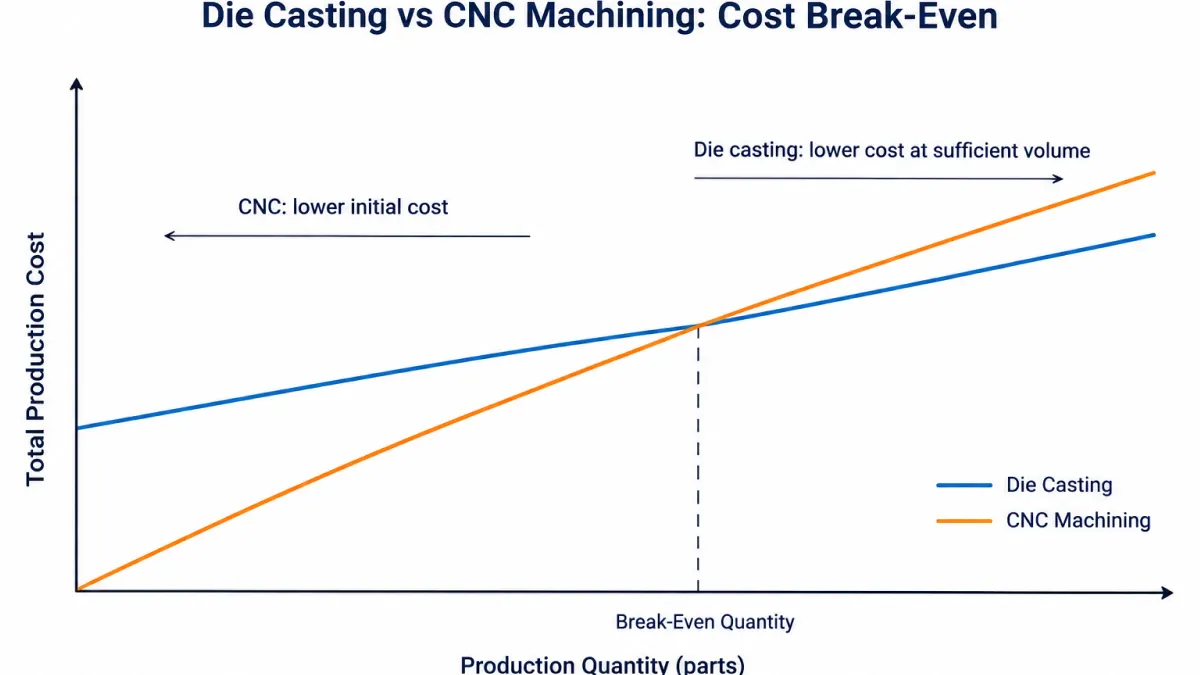
For a detailed breakdown of tooling and recurring casting expenses, see our guide to aluminum die casting cost.
Which Part Geometry, Material, and Design Stage Fit Each Process?
Thin walls, internal cavities, tool access, and part consolidation
Die casting can integrate ribs, bosses, mounting points, thin walls, and external detail in one repeatable operation. It may also consolidate several machined or assembled pieces. The design must still permit die opening, metal flow, venting, cooling, and ejection. Undercuts can require slides or additional operations, while thick isolated sections need close review for shrinkage and distortion.
CNC machining suits parts whose critical surfaces and cavities are accessible to a tool. Deep pockets, narrow internal passages, sharp internal corners, and multiple setups increase machining difficulty. A shape that removes most of a large billet deserves a casting review, especially when the same geometry repeats. Complexity alone does not settle the choice; tool access and die construction determine how that complexity is produced.
Cast alloys vs the wider CNC material range
Die casting commonly uses aluminum, zinc, and magnesium alloys formulated for castability. Meituo works with A380 and ADC12 for aluminum programs. CNC machining can process a much wider range, including wrought aluminum, carbon and stainless steels, copper alloys, titanium, engineering plastics, and cast blanks.
The specified grade affects more than procurement. A380 and 6061-T6 have different compositions, material forms, and performance characteristics. A CNC design in 6061-T6 cannot be transferred to A380 with only a geometry revision. Loads, ductility, corrosion environment, thermal conductivity, finishing, and applicable standards must be checked together. Our comparison of cast vs wrought aluminum alloys explains this material distinction.
Prototype iteration vs a stable production design
CNC machining is well suited to early prototypes and design revisions because the model and toolpaths can change without modifying a casting die. Die casting becomes more credible after fit, function, material assumptions, and demand have been validated. A drawing can remain technically changeable after tooling starts, but the cost and timing of each revision need to be included in the program decision.
How Do Tolerance, Surface Finish, and Strength Compare?
As-cast dimensions vs machined critical features
CNC machining generally provides tighter dimensional control on machined features. Die casting provides repeatable near-net geometry, but its tolerances vary with alloy, feature location, die construction, thermal behavior, and whether a dimension crosses a parting line or moving die component. The drawing should distinguish general cast dimensions from critical-to-quality features that may need secondary machining.
This distinction prevents an unfair comparison between an as-cast dimension and a finished machined dimension. On its washing machine spider, Meituo specifies bearing tolerance control within 0.005 mm for the finished component. That figure is a product-specific finished requirement, not a general as-cast tolerance for every aluminum die casting.
As-produced surfaces, finishing, and cosmetic requirements
Machined surfaces carry tool marks and can be produced to a specified roughness where function requires it. As-cast surfaces reflect die condition, alloy flow, release conditions, and part design. Gates, parting lines, ejector marks, and trimming locations need to be considered on visible or sealing surfaces.
Both routes may require deburring and finishing. Coating, plating, painting, polishing, and anodizing respond differently to alloy chemistry and surface condition. A cosmetic requirement should therefore be reviewed with the alloy and casting process, not added after the production route is fixed.
Why strength depends on alloy, material condition, porosity, and design
CNC machining does not automatically make a part stronger. It can machine wrought stock, forged stock, or a casting, and each starting material has a different structure and property range. Strength comparisons need a named alloy and temper or material condition, together with the load direction and failure mode.
Die-cast properties also depend on section design, solidification, gas and shrinkage porosity, inclusions, and process control. A ribbed casting can meet its service loads even when its nominal alloy properties differ from a machined wrought grade. For fatigue, impact, pressure tightness, or safety-critical use, compare drawing requirements and validation results rather than assuming a winner from the process name. Spectral analysis verifies alloy composition, while X-ray and mechanical or leak testing can address specific internal and functional risks.
When Should You Switch from CNC Machining to Die Casting?
A conversion review is justified when repeat demand is credible, the design is approaching stability, and billet machining creates substantial cost, material removal, or assembly work. The business case should survive a finished-part cost comparison and the technical review should confirm that the required alloy and geometry can be cast and verified.
Volume, demand stability, design freeze, and tooling readiness
- Annual volume, release pattern, product life, and spare-parts demand are documented.
- Fit, function, and major design interfaces have been validated.
- The material review covers mechanical, corrosion, thermal, and finishing requirements.
- The tooling budget and launch window include trials and potential revisions.
- Critical features have a defined casting, machining, and inspection route.
A CNC-to-die-casting design conversion checklist
| Review area | Questions before die release |
|---|---|
| Wall sections and radii | Can abrupt thickness changes, isolated heavy masses, and sharp corners be revised? |
| Draft and parting | Can the part release cleanly, and are parting-line locations acceptable? |
| Slides and ejection | Which undercuts need moving components, and where can ejector marks be placed? |
| Gating, venting, and cooling | How will the cavity fill and solidify without unacceptable defects or distortion? |
| Machining and datums | Which features need machining stock, and how will the cast blank be located consistently? |
| CTQ and appearance | Which dimensions, sealing areas, cosmetic surfaces, and tests define acceptance? |
| Lifecycle changes | Which interfaces must remain fixed, and how will maintenance or revisions be controlled? |
Prototype, DFM, trial, and production-ramp checkpoints
A controlled transition links CNC validation, casting-oriented DFM, die design, simulation, trial castings, dimensional and functional verification, and production release. Meituo uses UG for mold engineering and JSCAST for flow simulation, supported by die-casting and precision machining capabilities. These checkpoints allow the design and the cost model to be corrected before repeat production begins.
When Does It Make Sense to Combine Die Casting and CNC Machining?
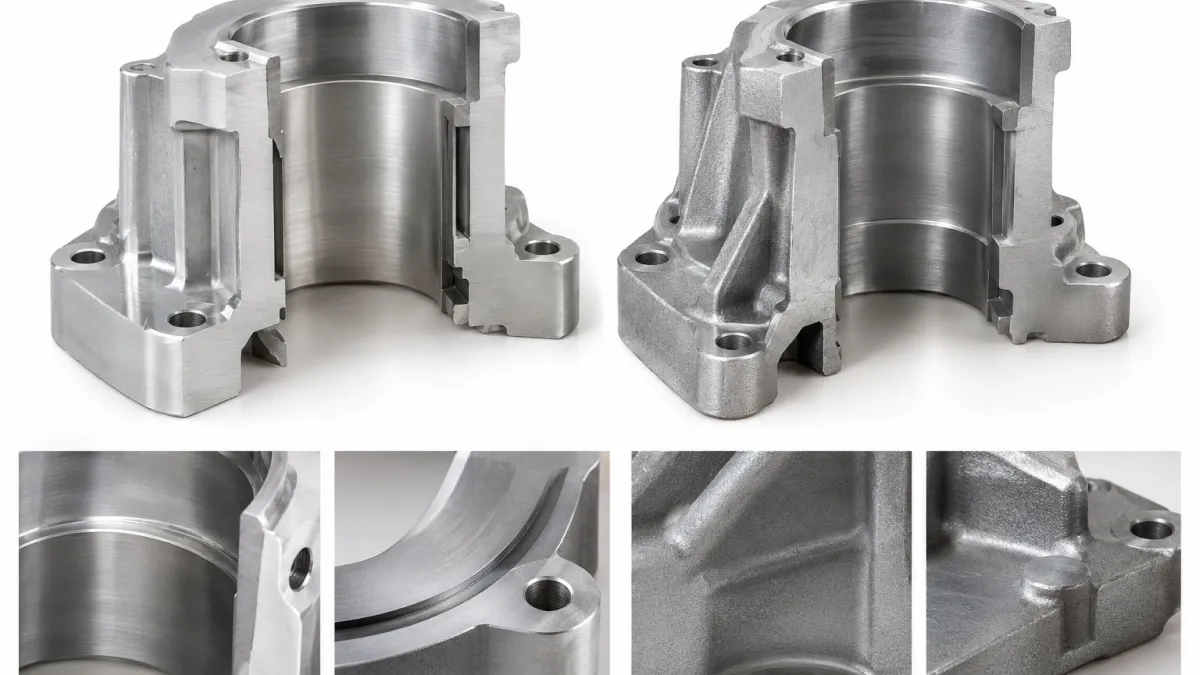
The combined route is appropriate when die casting can efficiently form most of the geometry while selected features need machined accuracy or finish. It reduces the amount of stock and cutting required for the overall shape without assuming that every cast feature will meet its final requirement directly.
Near-net-shape casting with machining only on critical features
The casting supplies the walls, ribs, bosses, and general envelope. CNC operations then address the features controlled by the functional drawing. This division requires enough machining stock, stable datums, accessible fixtures, and a clear distinction between cast and machined acceptance criteria.
Bearing bores, threads, sealing faces, and datum surfaces
Common candidates include precision bearing bores, threaded connections, gasket or sealing faces, and mounting datums. The decision should follow function. Noncritical cast features may remain as-cast, while critical surfaces receive the necessary machining and inspection. Meituo provides turning, milling, drilling, and tapping for die-cast products, allowing these requirements to be reviewed within one production plan.
What Should You Send for a Process Comparison and RFQ?
A useful comparison starts with a controlled drawing package and a common cost scope. Send the 2D drawing and 3D model, current and target alloy, annual and lifecycle volume, expected order releases, critical dimensions, surface requirements, applicable tests, target launch timing, and the current manufacturing route if available. Identify known cosmetic surfaces, pressure-tight areas, and features that cannot change.
| Buyer input | What the supplier should return |
|---|---|
| Drawing, model, and revision status | Geometry review, casting feasibility, and required design changes |
| Material and service requirements | Proposed alloy and any performance or finishing risks |
| Annual and lifecycle demand | Tooling concept, production route, and volume assumptions |
| CTQ, finishing, and testing | Machining, inspection, validation, and complete recurring cost scope |
| Timing and current cost basis | Comparable fixed and unit costs, break-even assumptions, and launch checkpoints |
Ask for the assumptions behind the comparison as well as the quoted numbers. Tooling, trials, maintenance, secondary machining, finishing, inspection, and future revisions can change the answer. A supplier should state which items are included and which remain subject to DFM or sample validation.
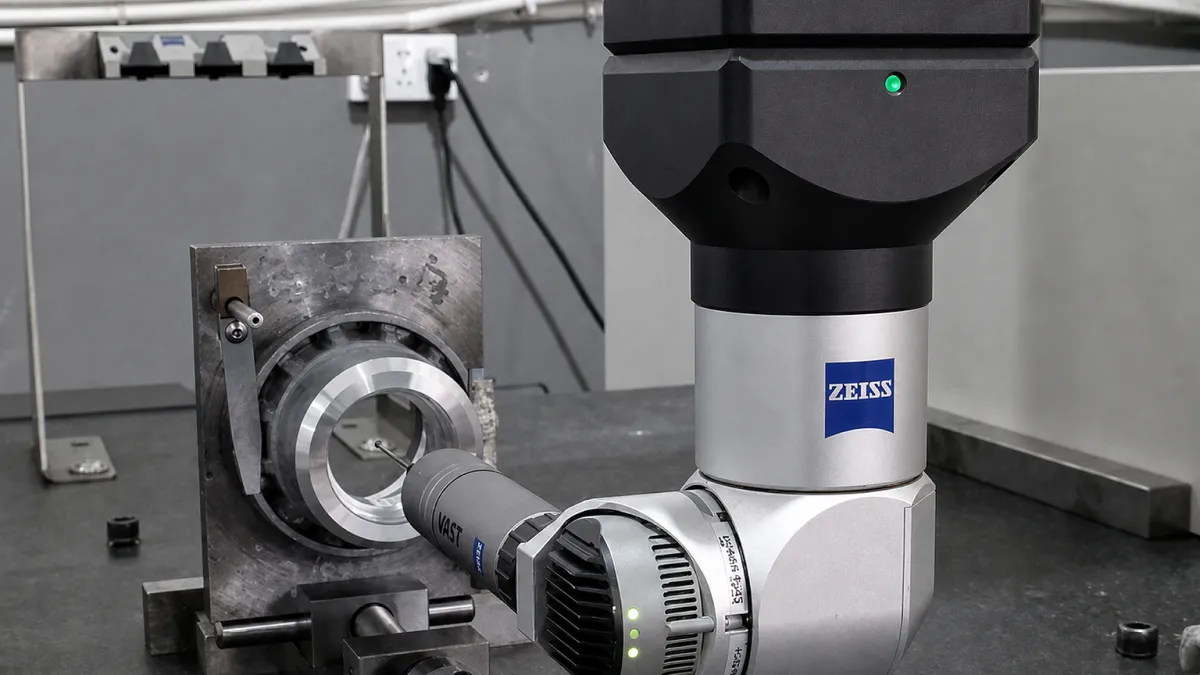
Meituo develops molds with UG and JSCAST, operates 20 aluminum die-casting machines from 160T to 1650T, and supports precision machining and inspection through equipment including spectral analyzers, Zeiss CMM, and X-ray systems. To review die casting and precision machining capabilities for your part, send the drawing and demand profile. For custom aluminum die casting, our team can assess the design, processing route, and quotation scope against your requirements.