Heat treatment is one of the most commonly misunderstood steps in aluminum casting production. Buyers often request "T6" without knowing which casting processes can actually support it — and suppliers sometimes agree without flagging the limitations. This guide covers the full picture: what each temper designation means, the correct process parameters for the most common casting alloys, and the critical difference between what works on gravity/permanent mold castings versus high-pressure die castings (HPDC).
Why Heat Treat Aluminum Castings?
Aluminum casting alloys like A356 are strong enough in the as-cast condition for many applications. But as-cast microstructure has limitations. Silicon particles form as coarse, irregular needles. Alloying elements like magnesium are distributed unevenly. Residual stresses from solidification are present throughout the part. Heat treatment changes all of this at the microstructural level.
The primary goals of aluminum casting heat treatment are:
- Dissolve alloying elements into solid solution and redistribute them uniformly
- Modify silicon morphology from acicular (needle-shaped) to spheroidal — improving ductility and fatigue resistance
- Create fine, evenly distributed precipitates (Mg₂Si and Al₂Cu) that block dislocation movement and increase strength
- Relieve residual stress from casting and quenching
- Improve dimensional stability for parts operating at elevated temperatures
The result depends entirely on which temper designation is applied and whether the casting process is compatible with the treatment.
Temper Designations Explained: T4, T5, T6, T7
Temper designations for aluminum are standardized by the Aluminum Association. For cast aluminum, the most relevant are:
| Temper | Process | Typical Result | Best For |
|---|---|---|---|
| F | As-cast, no heat treatment | Baseline properties, variable | Non-structural, decorative parts |
| T4 | Solution heat treat → quench → natural age (room temp, 4–12 hrs) | Moderate strength, good ductility | Parts requiring further forming or welding |
| T5 | Cool from casting → artificial age only (no solution treatment) | Moderate strength gain, low distortion risk | HPDC parts; extruded profiles |
| T6 | Solution heat treat → quench → artificial age | Peak strength, hardness | Gravity/permanent mold castings; structural parts |
| T7 | Solution heat treat → quench → over-age (higher temp or longer time) | Lower strength than T6, better thermal stability and SCC resistance | Parts in high-temp service; 7xxx alloys |
T6 is the most requested temper for structural aluminum castings. It typically increases strength by 30–40% over as-cast condition. T5 is the correct path for most HPDC components. T7 is used when dimensional stability at elevated temperature or stress corrosion cracking resistance matters more than peak strength.
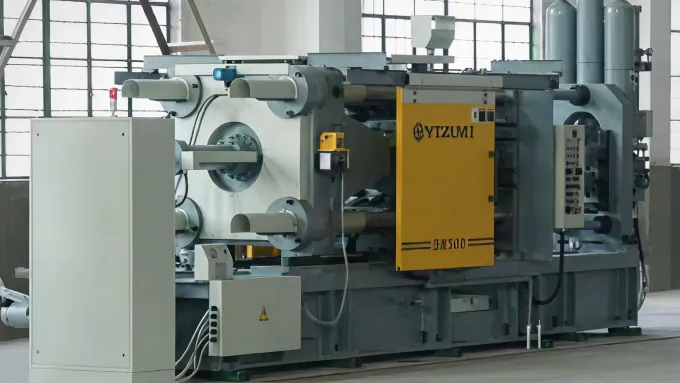
The T6 Process in Detail: Three Steps
T6 heat treatment for aluminum castings involves three sequential steps. Each must be controlled precisely — temperature uniformity, hold time, and quench speed all directly affect final properties.
Step 1 — Solution Heat Treatment (SHT)
The casting is loaded into a furnace and heated to a temperature just below the solidus — typically 515–545°C depending on the alloy. The purpose is to dissolve all soluble alloying elements (primarily Mg and Cu) into the aluminum matrix to form a uniform solid solution. Silicon particles also begin to spheroidize during this step, rounding from sharp needles into more globular shapes.
Hold time depends on section thickness and alloy. Thin-section castings (5–10mm) may need only 4 hours. Heavy sections (30–50mm) may require 10–12 hours. Insufficient time leaves alloying elements undissolved and reduces the aging response. Excessive time risks grain growth and incipient melting at grain boundaries.
Furnace temperature uniformity must be tight — typically ±6°C across the load. Hot spots above the solidus cause partial melting at grain boundaries. Cold spots produce incomplete solution and poor aging response.
Step 2 — Quenching
Immediately after SHT, the casting is transferred to a quench bath and rapidly cooled. The purpose is to "freeze" the supersaturated solid solution at room temperature — preventing the alloying elements from precipitating prematurely as coarse, incoherent particles that would not contribute to strength.
Transfer time from furnace to quench bath must be short — typically under 15 seconds for thin sections. Longer transfer times allow high-temperature precipitation to begin, permanently reducing the aging response.
Quench media options:
- Water (cold, 20–25°C): Fastest quench, maximum supersaturation retained — but highest distortion and residual stress risk
- Hot water (60–80°C): Common compromise — adequate quench rate for most alloys, reduced thermal shock and distortion
- Polymer quenchant (PAG solutions): Adjustable quench rate by concentration; useful for complex geometries prone to cracking or warping
- Forced air: Only suitable for alloys with lower quench sensitivity; often insufficient for A356
Step 3 — Artificial Aging (Precipitation Hardening)
After quenching, the part is placed in a lower-temperature oven (typically 150–175°C) for several hours. The elevated temperature accelerates the diffusion of Mg and Si atoms, causing them to cluster and precipitate as fine, coherent Mg₂Si particles within the aluminum matrix. These precipitates obstruct dislocation movement, producing the strength increase that defines T6.
Aging is time-temperature dependent. Peak hardness (T6 condition) is reached at a specific combination of temperature and time. Under-aging leaves strength below peak. Over-aging (which becomes T7 condition) causes the precipitates to grow too large, lose coherency, and drop in strengthening efficiency — reducing strength below peak but improving thermal stability and corrosion resistance.
Standard Parameters by Alloy
| Alloy | Casting Process | SHT Temperature | SHT Time | Quench | Aging Temp | Aging Time | Typical UTS (T6) |
|---|---|---|---|---|---|---|---|
| A356 | Gravity / permanent mold | 538°C ±6°C | 4–12 h | Hot water 65–100°C | 155°C ±5°C | 2–5 h | 240–280 MPa |
| A357 | Gravity / permanent mold | 538–543°C | 6–12 h | Hot water | 155–165°C | 3–6 h | 280–310 MPa |
| 319 | Sand / gravity | 505–525°C | 4–6 h | Hot water | 160–170°C | 8–10 h | 260–280 MPa |
| A380 (HPDC) | HPDC — T5 only | N/A | N/A | N/A | 175–200°C | 4–6 h | 210–230 MPa (T5) |
| ADC12 (HPDC) | HPDC — T5 only | N/A | N/A | N/A | 175–200°C | 4–6 h | ~220 MPa (T5) |
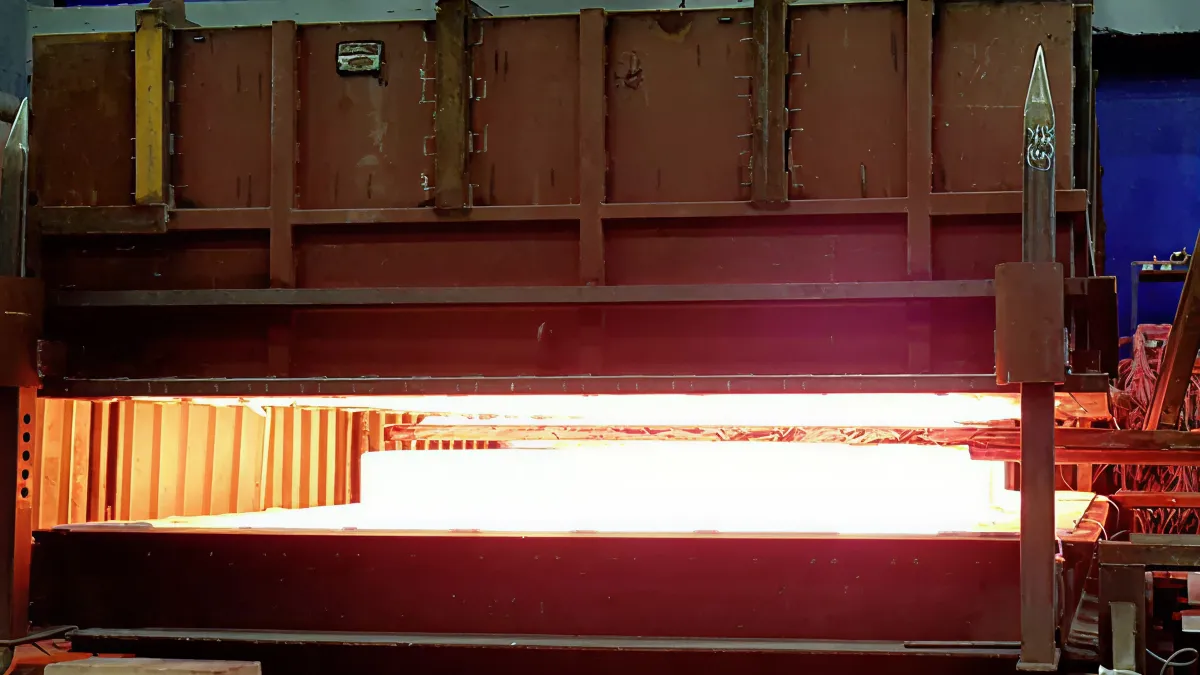
The HPDC Problem: Why Standard T6 Fails on Die Castings
This is the most important practical point in aluminum casting heat treatment — and the one most often mishandled in OEM specifications.
Standard high-pressure die casting (HPDC) parts cannot undergo conventional T6 solution treatment. During the high-speed die-filling process, air and die-release lubricants are inevitably trapped inside the part as micro-porosity and dissolved gas. When the part is heated to solution treatment temperature (515–545°C), these trapped gases expand. The result: surface blisters, dimensional distortion, and internal voids that expand into structural defects.
This is a fundamental metallurgical constraint, not a process control problem. The solution treatment temperature required to dissolve Mg₂Si precipitates into solution is close to or above the temperature at which trapped gas causes unacceptable expansion. Reducing SHT temperature to avoid blistering leaves the alloy understrength. There is no standard processing window that fully resolves this in conventional HPDC.
The correct approach for standard HPDC parts is T5: artificial age directly from the as-cast condition without any solution treatment. T5 aging stabilizes the microstructure, reduces residual stress, and provides moderate strength improvement (typically 15–25% over as-cast) without the blistering risk. This is the standard thermal treatment for A380, ADC12, and similar HPDC alloys.
For applications requiring T6 properties in a complex die cast geometry, three paths exist:
- Vacuum-assisted die casting (VADC): Evacuating the die cavity before injection reduces trapped gas, enabling full T6 without blistering. Used for structural automotive castings (shock towers, battery enclosures)
- Vacuum pressure impregnation (VPI) before HT: Sealing porosity with resin before heat treatment suppresses gas expansion. Less common due to cost and dimensional considerations
- Low-temperature "short-cycle T6": Solution treatment at 450–480°C for 15–30 minutes — below full dissolution temperature but above aging temperature. Partial solution + age; properties are between T5 and full T6. Used where standard T6 is not achievable but some improvement over T5 is needed
T6 vs T7: When to Over-Age
Some applications require T7 instead of T6. The distinction comes down to service conditions.
T6 delivers peak strength. But parts that operate continuously above 120–150°C will over-age in service — their precipitates coarsen, properties drift downward, and dimensions can change. If a part is going to thermally age anyway in service, it is better to intentionally over-age it to a stable T7 condition during manufacturing so that properties and dimensions are predictable and consistent throughout service life.
T7 is produced by aging at higher temperature (typically 175–205°C) or for longer time than T6. This grows the precipitates beyond peak coherency, reducing strength by 10–15% versus T6 but producing a microstructure that is stable at elevated temperature. T7 also offers improved stress corrosion cracking resistance, which is relevant for 7xxx alloys.
Typical T7 applications in our supply base include bearing housings and motor brackets exposed to sustained operating temperatures, and components where dimensional stability over thousands of operating hours is a design requirement.
Effect on Mechanical Properties: A356 Before and After Treatment
| Condition | UTS (MPa) | Yield Strength (MPa) | Elongation (%) | Hardness (HB) |
|---|---|---|---|---|
| A356 — as-cast (F) | ~160–180 | ~85–100 | 3–6 | ~55–70 |
| A356 — T5 | ~180–210 | ~120–150 | 3–5 | ~65–75 |
| A356 — T6 | 240–280 | 200–240 | 6–8 | 80–85 |
| A356 — T7 | 220–250 | 180–210 | 8–10 | 75–80 |
One frequently cited figure: T6 heat treatment increases A356 tensile strength by approximately 106% over as-cast condition in gravity die castings. Hardness sees a similar improvement. Elongation — often counterintuitively — also improves under T6 versus as-cast, because silicon particle spheroidization during SHT reduces the stress-concentrating effect of acicular Si that causes early fracture initiation in as-cast parts.
Common Heat Treatment Defects and How to Avoid Them
| Defect | Cause | Prevention |
|---|---|---|
| Surface blistering | Trapped gas expanding during SHT (HPDC) | Use T5 for standard HPDC; use VADC if T6 required |
| Dimensional distortion / warping | Thermal gradients during quench; inadequate fixturing | Hot water quench; polymer quench for complex parts; proper fixture design |
| Under-strength after aging | Insufficient SHT time; delayed quench; under-aging | Verify time-temperature curves; minimize transfer time; follow specified aging cycle |
| Quench cracking | Rapid thermal shock in cold water on thick sections or stress concentrations | Pre-quench stress relief; hot water or polymer quench; avoid sharp corners in design |
| Intergranular melting | SHT temperature above solidus (pyrometry error or hot spots) | Tight furnace TUS/SAT calibration (±6°C); avoid overloading furnace |
How Meituo Handles Heat Treatment in Production
At Meituo, we supply gravity-cast and permanent mold A356 components to T6 specification for motor housings, bearing seats, and structural brackets. Our heat treatment operations run in-house with temperature-recorded batch furnaces — you can see our production facility at our factory overview. Every heat treatment cycle produces a time-temperature record traceable to the part lot. Hardness testing (Brinell) is performed on each batch to confirm aging response before parts are released for secondary operations. Our quality systems and certifications are listed on our certifications page.
For HPDC components where OEM specifications call for T5, we apply artificial aging as part of the standard process flow. Where engineering teams request T6 on HPDC geometries, we flag the constraint early in the quoting process and recommend process alternatives — either VADC tooling design or switching to gravity casting if the geometry permits — rather than producing parts that will not meet specification.
If you have an aluminum casting project that requires a specific temper designation, send us your drawing and performance requirements via our support page. We will confirm the feasible heat treatment path for your geometry and production volume.