Zamak 3 is the default zinc die casting alloy. Designated ASTM AG40A (UNS Z33520), it accounts for more than 70% of all zinc die castings in North America, and it is the grade a part gets specified in unless there is a clear reason to choose something else. Its appeal is balance: good strength, good ductility, the best long-term dimensional stability of the Zamak family, and excellent plating quality, all at the lowest cost.
This page gives the full technical picture: chemical composition to ASTM B86, mechanical and physical data, casting behavior, why the copper-free chemistry matters, how it differs from Zamak 5, equivalent international grades, and where it is used in production. If you are choosing between grades, start here and compare against the rest of the zinc casting alloy family.
Zamak 3 Chemical Composition
Zamak 3 is roughly 96% zinc and 4% aluminum, with tightly controlled magnesium and very low impurity limits. The aluminum drives strength and castability; the small magnesium addition refines grain structure and suppresses intergranular corrosion. Copper is held to a trace, which is the defining feature of the grade.
| Element | Die Cast (ASTM B86) % | Ingot (ASTM B240) % |
|---|---|---|
| Aluminum (Al) | 3.7–4.3 | 3.9–4.3 |
| Magnesium (Mg) | 0.02–0.06 | 0.03–0.06 |
| Copper (Cu) | 0.10 max | 0.10 max |
| Iron (Fe) | 0.05 max | 0.035 max |
| Lead (Pb) | 0.005 max | 0.004 max |
| Cadmium (Cd) | 0.004 max | 0.003 max |
| Tin (Sn) | 0.002 max | 0.0015 max |
| Zinc (Zn) | Balance | Balance |
The low lead, cadmium, and tin caps matter. These impurities are what caused early zinc castings to swell and crack from intergranular corrosion. Modern high-purity Zamak 3 controls them tightly, which is why aged parts stay sound. Spectrometer verification on incoming metal is the practical safeguard against off-spec ingot.
Mechanical Properties
The values below are typical for as-cast die cast test bars. Real parts vary with wall thickness, since thinner sections cool faster and come out stronger.
| Property | Value (Metric) | Value (Imperial) |
|---|---|---|
| Ultimate tensile strength | 283 MPa | 41 ksi |
| Yield strength (0.2%) | 221 MPa | 32 ksi |
| Elongation (in 50 mm) | 10% | 10% |
| Brinell hardness | 82 HB | 82 HB |
| Shear strength | 214 MPa | 31 ksi |
| Impact strength (unnotched) | 58 J | 43 ft·lb |
| Modulus of elasticity | 85.5 GPa | 12.4 ×10⁶ psi |
| Fatigue strength | 48 MPa | 7 ksi |
Physical Properties
| Property | Value |
|---|---|
| Density | 6.6 g/cm³ |
| Melting range | 381–387°C |
| Thermal conductivity | 113 W/m·K |
| Coefficient of thermal expansion (20–100°C) | 27.4 µm/m·°C |
| Electrical conductivity | 27% IACS |
| Specific heat | 419 J/kg·K |
Casting Characteristics
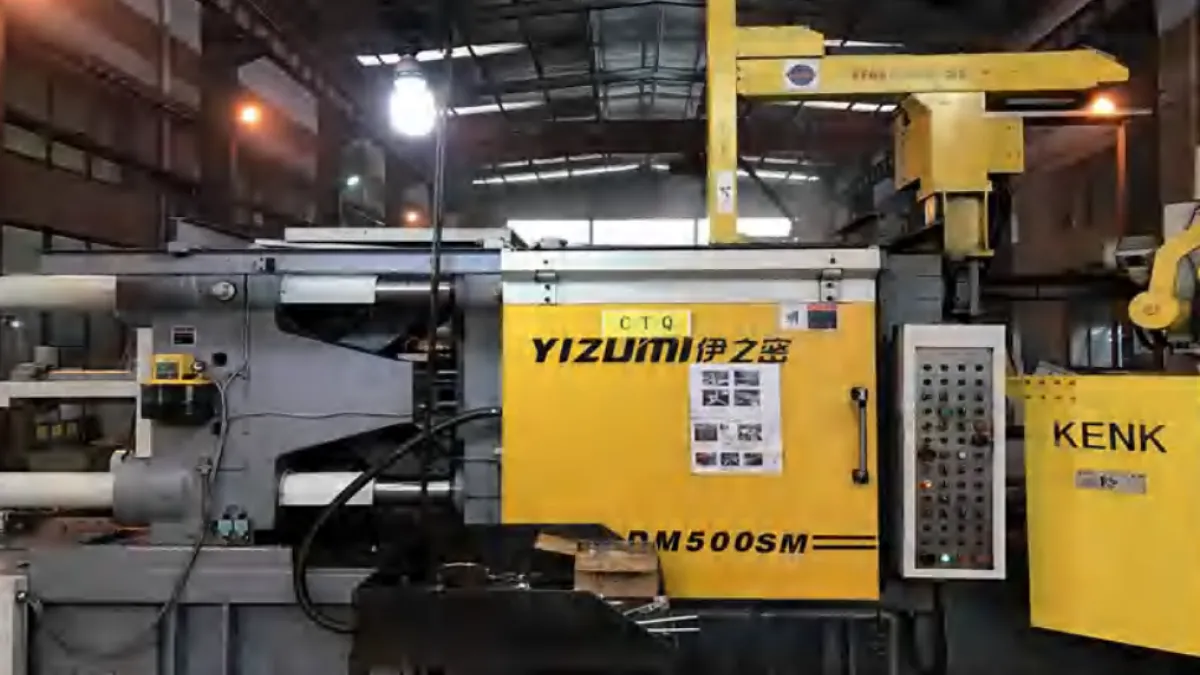
Zamak 3 is one of the easiest alloys to die cast, which is a large part of why it is the standard. The low melting point lets it run on hot-chamber machines with short, efficient cycles. Its fluidity fills thin sections cleanly, down to about 0.5 mm wall thickness on well-designed parts, so it reproduces fine detail, crisp text, and tight features.
Two casting traits define its production value. First, dimensional stability: Zamak 3 holds tight tolerances during casting and keeps them over the part's service life, which reduces secondary machining. As-cast tolerances of roughly ±0.05 mm on small features are achievable, and net-shape casting often eliminates machining entirely. Second, die life. Because zinc is gentle on tool steel at hot-chamber temperatures, a well-built Zamak 3 die routinely runs past one million shots, spreading tooling cost across a very large volume. For the full process detail, see our zinc die casting process guide.
Zamak 3 also casts threads, lettering, and cored holes cleanly, so many features that would be machined in aluminum or steel come straight off the tool. Its excellent damping capacity is a quieter benefit: parts absorb vibration well, which helps in housings, covers, and mechanism components where noise matters.
Corrosion Resistance and Finishing
Zinc forms a stable protective oxide layer, so bare Zamak 3 resists normal indoor atmospheric corrosion without coating. For outdoor or aggressive environments, a finish is added. Zamak 3 accepts the full range of finishes: decorative chrome and nickel electroplating, copper undercoats, powder coating, wet paint, chromate conversion, and electrophoretic coatings. Its copper-free chemistry gives a clean, repeatable plating base, which is why high-gloss decorative parts default to this grade. For finish selection by application, see our zinc die casting surface finishing guide.
The Copper-Free Advantage
Zamak 3 carries essentially no copper, and that single choice explains most of its behavior. Copper raises strength and hardness, but it also drives slow dimensional change over time and reduces impact toughness. By leaving it out, Zamak 3 gains three things: the best long-term dimensional stability of the family, the best ductility and secondary-forming behavior of the common grades, and the most consistent plating and finishing response. These are exactly the traits that decorative and precision parts need, which is why Zamak 3 dominates plated hardware. If a part instead needs more load capacity, that is the moment to look at a copper-bearing grade.
Zamak 3 vs. Zamak 5: Key Differences
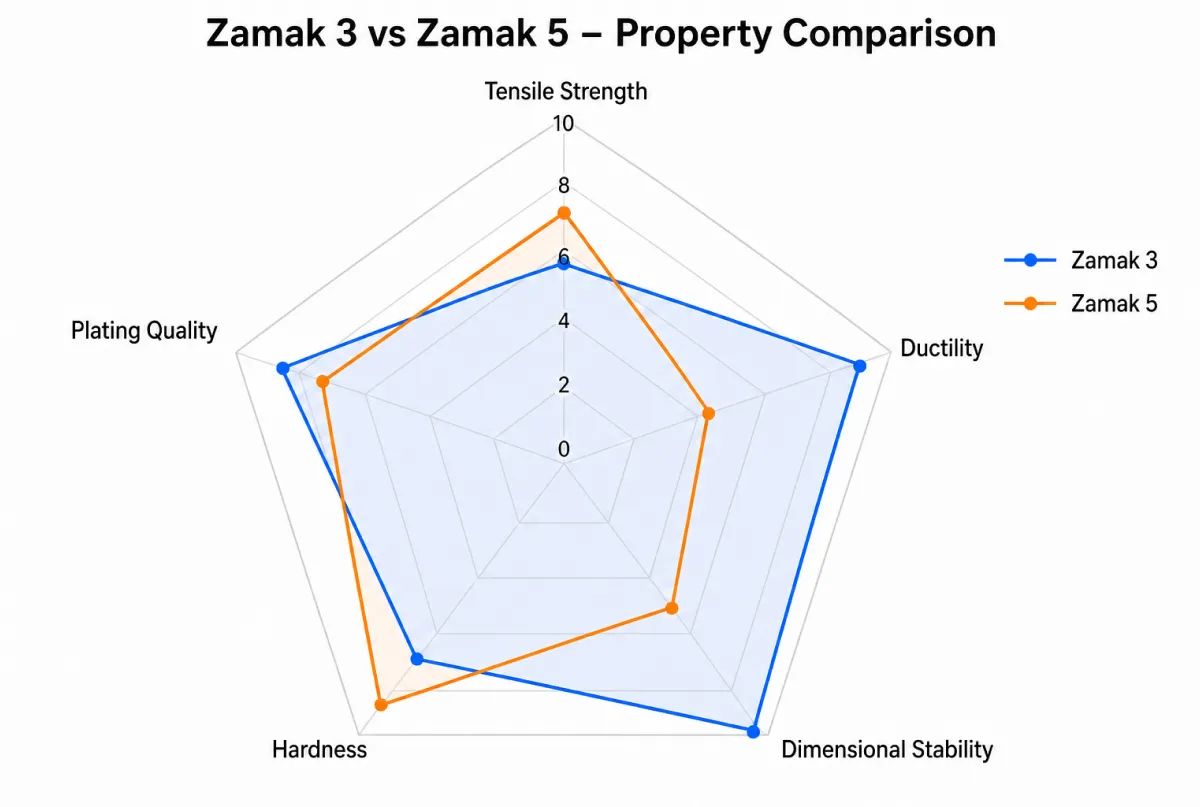
This is the comparison most buyers make. Zamak 5 is Zamak 3 with about 1% copper added. The copper buys strength and hardness but costs ductility and some long-term stability.
| Property | Zamak 3 | Zamak 5 |
|---|---|---|
| Copper content | ≤0.10% | 0.75–1.25% |
| Tensile strength | 283 MPa | 328 MPa |
| Yield strength | 221 MPa | 269 MPa |
| Elongation | 10% | 7% |
| Hardness | 82 HB | 91 HB |
| Long-term dimensional stability | Excellent | Good |
| Ductility / formability | Higher | Lower |
| Best for | General, decorative, plated parts | Higher load, wear, strength |
Choose Zamak 3 for the majority of plated hardware, housings, and detail parts. Step up to Zamak 5 when the part sees moderate load or wear and the slight loss of ductility is acceptable. The full breakdown is in our Zamak 5 comparison.
Equivalent Grades and International Designations
Zamak 3 appears under several names across regions. They refer to the same alloy.
| Standard / System | Designation |
|---|---|
| ASTM B86 | AG40A |
| UNS | Z33520 |
| EN 12844 | ZP0400 (ZnAl4) |
| JIS H5301 | ZDC2 |
| Common names | Zinc Alloy 3, Alloy 3, Mazak 3, ZL3 |
Typical Applications
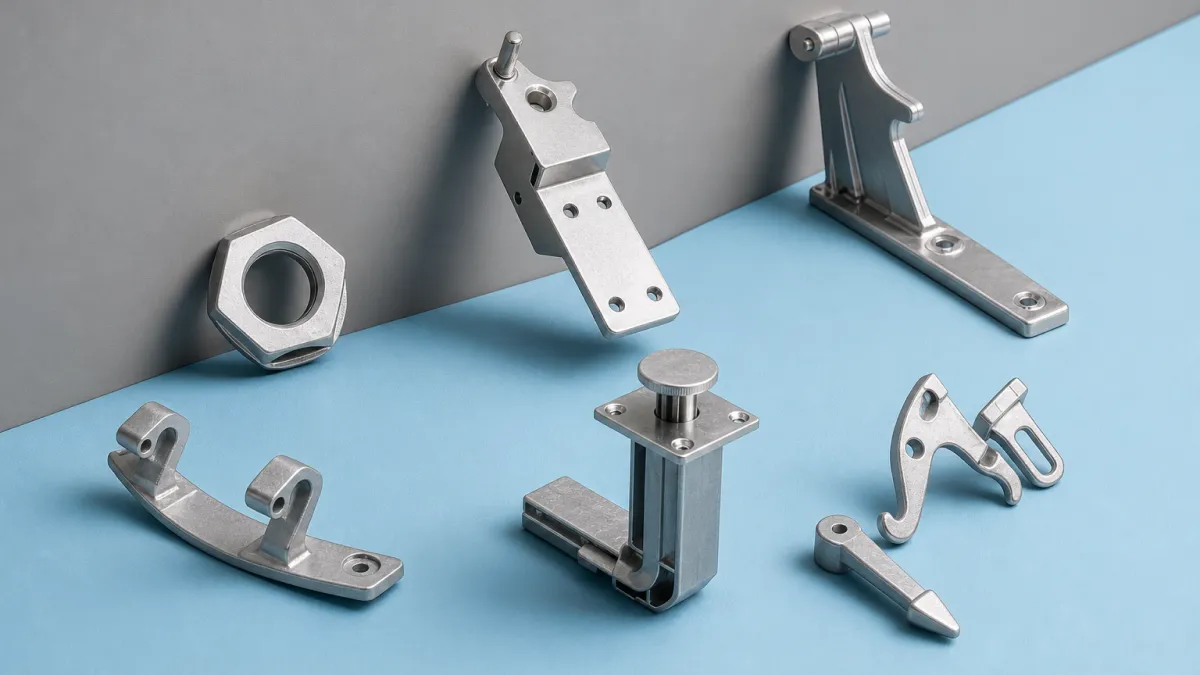
Zamak 3 shows up wherever a part needs crisp detail, a quality plated or painted finish, stable dimensions, and high volume at low cost. Common examples by sector:
Hardware and decorative: door handles, knobs, locks, hinges, drawer pulls, zippers, buckles, badges, and emblems destined for chrome or nickel plating.
Plumbing: faucet bodies, valve components, hose fittings, and shower fixtures.
Automotive: trim, interior hardware, brackets, and small mechanism parts.
Electrical and electronics: connector shells, housings, EMI shielding covers, and small structural components.
Consumer goods: toys, model parts, appliance trim, and tool components.
Limitations: When to Choose Another Grade
Zamak 3 is the right default, but it has clear boundaries. Knowing them prevents field failures.
Service temperature. Like all zinc alloys, Zamak 3 loses strength above roughly 100–120°C and is not suited to sustained high-heat service. For elevated-temperature duty, ZA-8 or EZAC hold up better.
Strength ceiling. At 283 MPa tensile, Zamak 3 covers general loads but not heavy structural ones. For higher strength at hot-chamber speeds, move to Zamak 5, Zamak 2, or ZA-8.
Creep under sustained load. Copper-free chemistry means lower creep resistance than the copper-bearing grades. For parts that carry a constant load for years, Zamak 2 or a ZA alloy is the safer pick.
Weight. At 6.6 g/cm³, zinc is dense. Where weight is critical and strength allows, aluminum die casting is the alternative; see our zinc vs aluminum comparison.
Specify Zamak 3 With Confidence
Getting consistent Zamak 3 parts is less about the alloy and more about control around it: verified incoming metal, stable melt and die temperatures, sound gating, and a finishing line tuned to the plating spec. At Meituo, we run hot-chamber zinc die casting in-house, verify incoming ingot by spectrometer, and inspect first articles for both dimensions and finish before a program ramps. Send us your drawing and target finish, and our engineering team will confirm whether Zamak 3 is the right grade and return a DFM review and quote.