Zinc casting alloys split into two families: the conventional Zamak grades and the higher-aluminum ZA grades. Both pour cleanly, hold tight tolerances, and take plating well, which is why zinc dominates small, detailed, decorative, and pressure-tight parts. The grades inside each family behave very differently, though. Pick the wrong one and it shows up later as soft threads, cracked rivets, slow cycle times, or finish rejects.
This guide covers the seven grades you will actually specify in production: Zamak 2, 3, 5, and 7, plus ZA-8, ZA-12, and ZA-27. It also touches the two specialty alloys (ACuZinc and EZAC) that come up for high-load and high-temperature work. You get composition limits, mechanical data, the hot-chamber versus cold-chamber split, and international standard equivalents, followed by a selection logic you can apply directly to your own drawing.
The Two Families: Zamak vs. ZA
Zamak alloys hold aluminum at a fixed level near 4%, with small magnesium additions (0.02–0.06%) and copper from zero to about 3% depending on grade. That stable chemistry is what makes them so forgiving in zinc die casting and gives them excellent dimensional stability over time. ZA alloys carry much more aluminum, named by their approximate aluminum content: ZA-8 (~8%), ZA-12 (~11%), and ZA-27 (~27%). The extra aluminum raises strength, hardness, wear resistance, and creep performance, and lowers density.
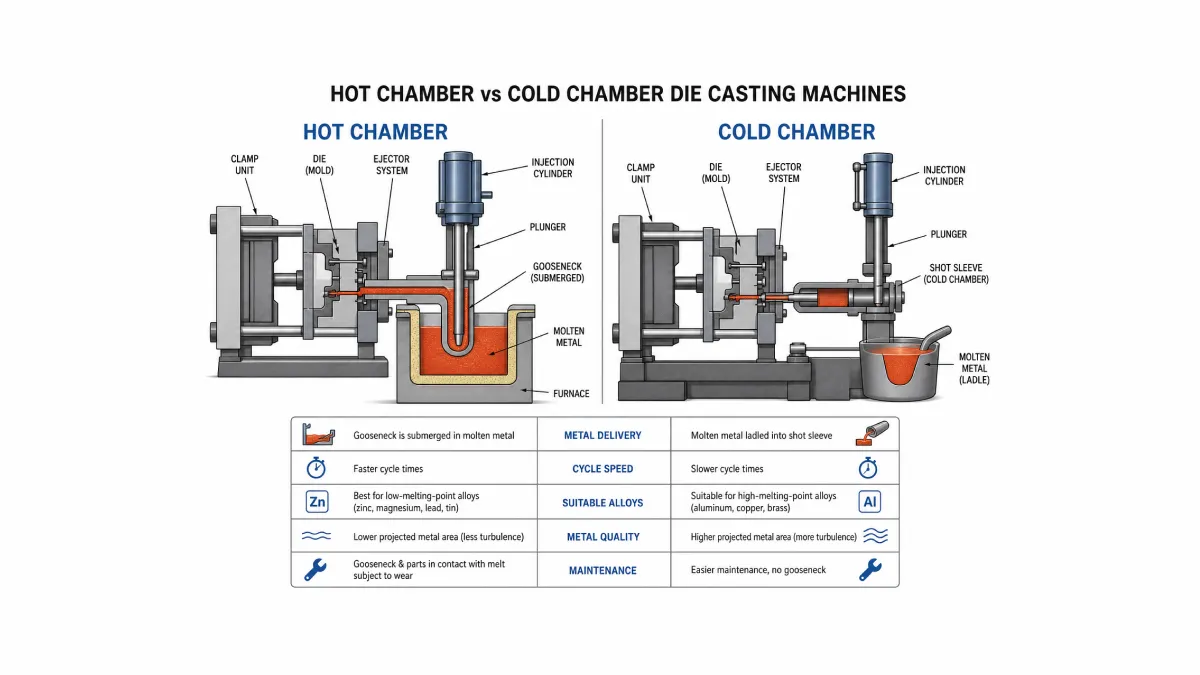
The practical dividing line is the casting process. Zamak grades and ZA-8 run on the fast, automated hot-chamber process. ZA-12 and ZA-27 carry too much aluminum for hot-chamber equipment (the molten metal attacks the steel gooseneck and plunger), so they must be cold-chamber die cast or gravity cast. That single fact drives cycle time, tooling, and per-part cost, so it usually decides the alloy before strength does.
Zamak Alloys: The Hot-Chamber Workhorses
Over 70% of North American zinc die castings are poured in a single Zamak grade. These four cover almost every commercial part.
Zamak 3 (Alloy 3)
The global default. It carries no intentional copper, which gives it the best long-term dimensional stability of the family along with a clean balance of strength, ductility, castability, and finish quality. If a part does not have a specific reason to need something else, it is cast in Zamak 3. Typical uses: hardware, brackets, housings, decorative trim, and anything destined for chrome or nickel plating.
Zamak 5 (Alloy 5)
Zamak 3 plus about 1% copper. The copper adds roughly 10–15% tensile strength and higher hardness, at the cost of some ductility. It is the European default and the right call when a part sees moderate load or wear but still needs good castability and plating. Note that lower ductility makes Zamak 5 less forgiving in secondary forming operations like riveting, crimping, or swaging. For the full breakdown, see our Zamak 5 vs Zamak 3 comparison.
Zamak 2 (Alloy 2, "Kirksite")
The highest copper (2.5–3%), and the strongest and hardest of the Zamak grades. It holds creep resistance and wear performance better than the others, which suits cams, gears, and parts under steady mechanical load for years. The trade-off is the lowest ductility in the family and a slow, small dimensional change over time from the high copper. Specify it only when wear or hardness is the driving requirement.
Zamak 7 (Alloy 7)
A high-purity version of Zamak 3 with lower magnesium and tighter impurity limits. Those changes improve fluidity, ductility, and surface finish. Reach for Zamak 7 on thin-walled parts, fine ribs, small bosses, logos, and visible faces that have to polish and plate to a premium standard.
| Grade | Al % | Cu % | Mg % | Tensile (MPa) | Elong. % | Hardness (HB) | Best for |
|---|---|---|---|---|---|---|---|
| Zamak 3 | 3.5–4.3 | ≤0.10 | 0.02–0.05 | 283 | 10 | 82 | General-purpose, plated hardware |
| Zamak 5 | 3.5–4.3 | 0.75–1.25 | 0.03–0.06 | 328 | 7 | 91 | Higher strength, moderate wear |
| Zamak 2 | 3.5–4.3 | 2.5–3.0 | 0.02–0.05 | 359 | 7 | 100 | Highest strength/hardness, wear parts |
| Zamak 7 | 3.5–4.3 | ≤0.10 | 0.005–0.020 | 283 | 13 | 80 | Thin walls, fine detail, premium finish |
All four share a density near 6.6 g/cm³ and a melting range around 381–387°C. Values above are typical for as-cast die castings; thin-section properties run higher because of faster cooling.
ZA Alloys: Higher Aluminum, Higher Strength
The ZA family was developed first for gravity casting and later adapted to die casting. Compared with Zamak, ZA alloys are stronger, harder, more wear-resistant, and lighter, and they perform better at elevated temperature. They make sense when a zinc part is replacing machined steel, cast iron, or bronze, especially where an integral bearing surface can remove an assembly step.
ZA-8
The bridge grade. With about 8% aluminum, ZA-8 is the only ZA alloy that runs on hot-chamber equipment, so you keep fast cycle times while gaining strength and creep resistance over Zamak 5. It also plates and finishes with standard zinc procedures. When a part is marginal in Zamak 3 or 5, ZA-8 is usually the first upgrade.
ZA-12
The most versatile ZA alloy. It casts well by gravity, permanent mold, graphite mold, and cold-chamber die casting, and it offers an excellent mix of strength and bearing performance. ZA-12 is the common choice for medium-volume structural and bearing parts where die-cast tooling cost is hard to justify. It is platable, though adhesion is weaker than the Zamak grades because of the higher aluminum.
ZA-27
The strongest and lightest zinc casting alloy, with yield strength near 365 MPa and density around 5.0 g/cm³. It delivers outstanding bearing and wear performance, but it is the most demanding to cast: it needs cold-chamber processing, careful melt control, and intensification pressure to avoid shrinkage porosity. ZA-27 is not recommended for plating. Use it when raw strength or wear resistance is the goal and the surface is functional rather than cosmetic.
| Grade | Al % | Cu % | Tensile (MPa) | Elong. % | Hardness (HB) | Density (g/cm³) | Casting method |
|---|---|---|---|---|---|---|---|
| ZA-8 | 8.0–8.8 | 0.8–1.3 | 374 | 6–10 | 100–106 | 6.3 | Hot chamber |
| ZA-12 | 10.5–11.5 | 0.5–1.25 | 400 | 4–7 | 95–115 | 6.0 | Cold chamber / gravity |
| ZA-27 | 25.0–28.0 | 2.0–2.5 | 425 | 2–3.5 | 116–122 | 5.0 | Cold chamber / gravity |
Specialty High-Performance Alloys
Two proprietary grades show up when standard zinc runs out of room. ACuZinc5, developed by General Motors, reaches strength and hardness near ZA-12 while staying hot-chamber castable, with strong wear performance; the trade-off is faster wear on the machine shot-end components. EZAC is the most creep-resistant zinc die casting alloy available, with yield strength around 393 MPa and hardness of 102–140 HB, and it is hot-chamber castable without the equipment wear seen with ACuZinc5. Both are niche choices for high-load or high-temperature parts, not general production grades.
Hot Chamber vs. Cold Chamber: Which Alloys Run Where
Castability is the first filter in alloy selection. Hot-chamber casting submerges the injection system in the molten zinc, which gives short metal paths, fast cycles, and excellent repeatability. Cold-chamber casting ladles metal into a separate shot sleeve for each shot, which is slower and adds cost. Here is the split:
| Process | Alloys | Why |
|---|---|---|
| Hot chamber | Zamak 2, 3, 5, 7; ZA-8; ACuZinc5; EZAC | Low aluminum, low melting point, minimal iron attack on equipment |
| Cold chamber / gravity | ZA-12, ZA-27 | High aluminum attacks the gooseneck; higher melt temperature |
The takeaway: if you need a high-strength zinc part at hot-chamber speeds, ZA-8 is the ceiling. Going to ZA-12 or ZA-27 buys more strength but moves you to a slower, more expensive process.
International Standards Cross-Reference
The same alloy carries different names across regions, which causes confusion on drawings and RFQs. This table maps the common grades to the main standards.
| Common name | ASTM B86 | UNS | EN 12844 | JIS H5301 |
|---|---|---|---|---|
| Zamak 3 | AG40A | Z33520 | ZP0400 (ZnAl4) | ZDC2 |
| Zamak 5 | AC41A | Z35531 | ZP0410 (ZnAl4Cu1) | ZDC1 |
| Zamak 2 | AC43A | Z35541 | ZP0430 (ZnAl4Cu3) | — |
| Zamak 7 | AG40B | Z33523 | ZP0402 | — |
| ZA-8 | — | Z35636 | ZP0810 | — |
| ZA-12 | — | Z35631 | ZP1110 | — |
| ZA-27 | — | Z35841 | ZP2720 | — |
How to Select the Right Zinc Alloy
Work the decision in this order. Castability and finish usually settle it before strength does.
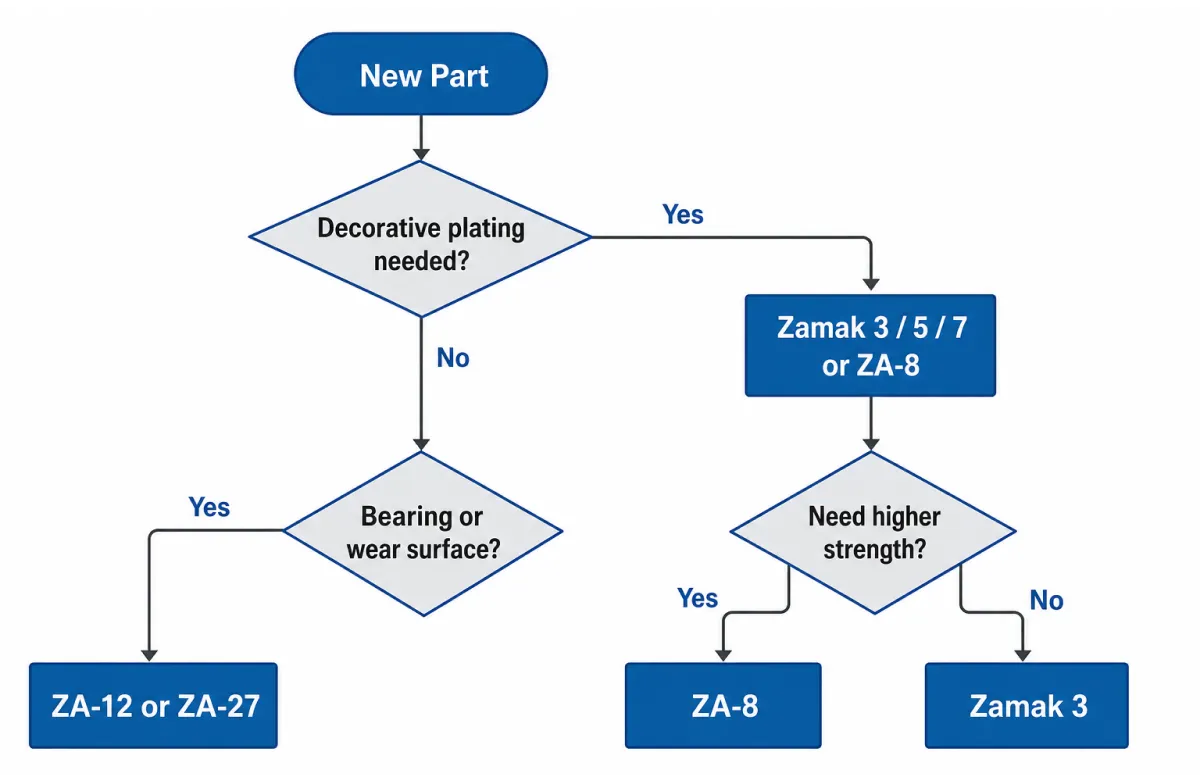
Start with Zamak 3. It handles the majority of plated hardware, housings, and brackets at the lowest cost. Only move off it for a specific reason.
Need more strength or wear, still want hot-chamber speed? Step up to Zamak 5 first, then Zamak 2 if hardness is critical, then ZA-8 if you need a real strength jump without leaving hot chamber.
Thin walls, fine detail, or top-tier cosmetic finish? Choose Zamak 7 for fluidity and polishability.
Replacing steel, iron, or bronze, or need an integral bearing? Move to the ZA family. ZA-12 for versatile structural and bearing parts; ZA-27 when maximum strength and minimum weight matter and the surface is functional.
Check the finish plan early. If the part must chrome or nickel plate to a decorative standard, stay with Zamak or ZA-8. ZA-12 plates with reduced adhesion; ZA-27 is not recommended for plating.
Confirm service temperature. All zinc alloys lose strength above roughly 100–120°C. For sustained heat, the higher-aluminum ZA grades and EZAC hold up better, but verify against your duty cycle.
Get the Right Alloy Specified for Your Part
Alloy choice interacts with wall thickness, gating, finish, and volume, so the cleanest path is to settle it during design review rather than after the first tool. At Meituo, we run hot-chamber zinc die casting in-house and select the grade against your strength, finish, and cost targets, then back it with spectrometer verification on incoming metal and dimensional inspection on first articles. Send us your drawing and the finish you are aiming for, and our engineering team will return an alloy recommendation, a DFM review, and a quote. Explore our zinc die casting capabilities to see the grades and finishes we run in production.