Zamak 5 is the high-strength counterpart to Zamak 3. Designated ASTM AC41A (UNS Z35531), it shares the same 4% aluminum base but adds about 1% copper, and that one change raises tensile strength by roughly 16%, hardness by about 10%, and creep resistance by a clear margin. It is the most widely specified zinc die casting alloy in Europe, and in North America it is the standard step up when a Zamak 3 part runs out of strength.
This guide gives the full technical record: chemical composition to ASTM B86, mechanical and physical property data, what the copper addition changes in service, a side-by-side comparison with Zamak 3, equivalent international grades, and the applications where the extra strength earns its cost. For the wider family, see our zinc casting alloy guide.
What Is Zamak 5?
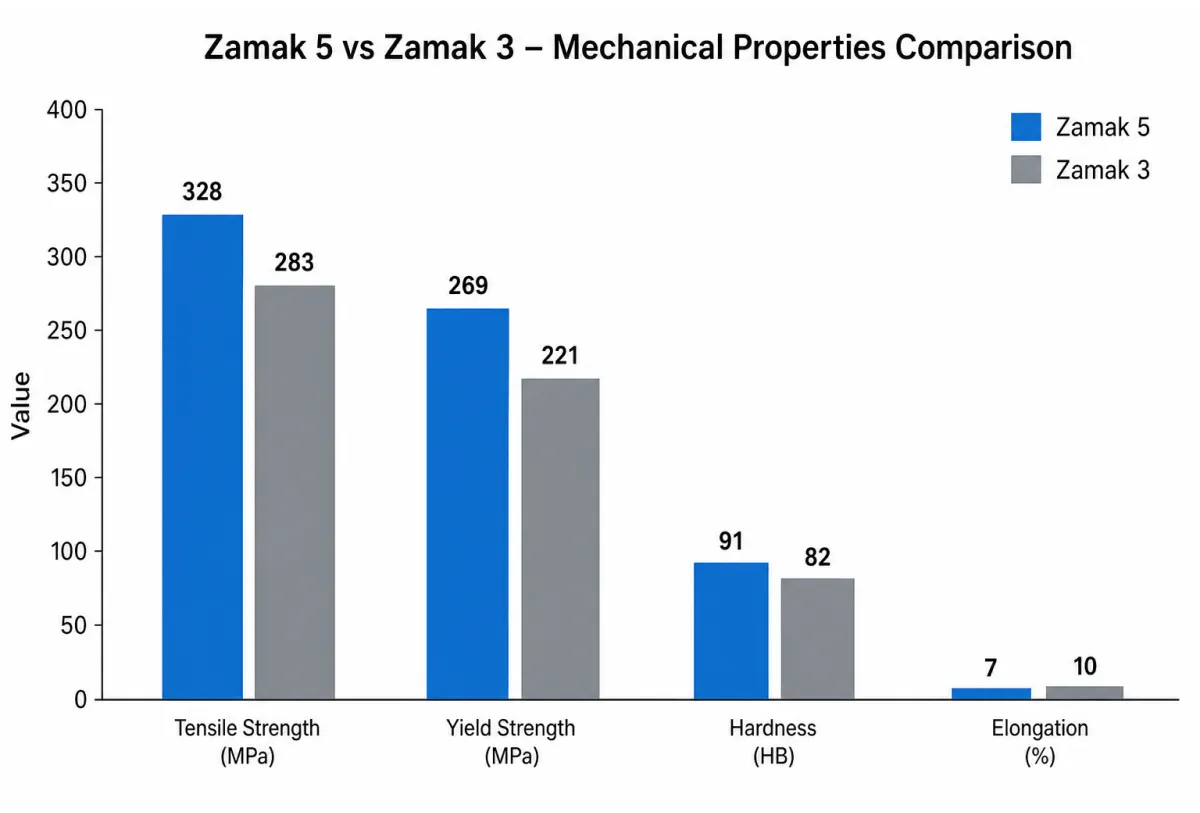
Zamak 5 is a hot-chamber zinc die casting alloy made of roughly 95% zinc, 4% aluminum, 1% copper, and a small magnesium addition. As cast, it delivers 328 MPa tensile strength, 269 MPa yield strength, 91 HB hardness, and 7% elongation. It runs on the same fast hot-chamber machines and the same dies as Zamak 3, casts thin walls and fine detail, and accepts chrome and nickel plating. Buyers specify it when a part must carry load, resist wear, or hold a sustained stress that would slowly deform Zamak 3.
Zamak 5 Chemical Composition
The composition is Zamak 3 chemistry plus a deliberate copper addition of 0.7–1.2%. Aluminum drives castability and base strength, magnesium refines the grain and suppresses intergranular corrosion, and copper strengthens the zinc matrix by solid-solution and precipitation effects.
| Element | Die Cast (ASTM B86) % | Ingot (ASTM B240) % |
|---|---|---|
| Aluminum (Al) | 3.7–4.3 | 3.9–4.3 |
| Copper (Cu) | 0.7–1.2 | 0.7–1.1 |
| Magnesium (Mg) | 0.02–0.06 | 0.03–0.06 |
| Iron (Fe) | 0.05 max | 0.035 max |
| Lead (Pb) | 0.005 max | 0.004 max |
| Cadmium (Cd) | 0.004 max | 0.003 max |
| Tin (Sn) | 0.002 max | 0.0015 max |
| Zinc (Zn) | Balance | Balance |
Impurity limits matter as much as the main elements. Lead, cadmium, and tin above spec cause intergranular corrosion, the swelling and cracking failure known as zinc pest that affected early castings. Modern high-purity ingot holds these elements to a few thousandths of a percent, and spectrometer checks on incoming metal are the practical way to confirm every lot is on spec before it reaches the furnace.
Mechanical Properties
Values below are typical for as-cast die cast test bars per industry datasheets. Actual parts vary with wall thickness: thin sections cool faster, form a finer skin, and test stronger than thick ones.
| Property | Value (Metric) | Value (Imperial) |
|---|---|---|
| Ultimate tensile strength | 328 MPa | 48 ksi |
| Yield strength (0.2%) | 269 MPa | 39 ksi |
| Elongation (in 50 mm) | 7% | 7% |
| Brinell hardness | 91 HB | 91 HB |
| Shear strength | 262 MPa | 38 ksi |
| Impact strength (unnotched) | 65 J | 48 ft·lb |
| Modulus of elasticity | 85.5 GPa | 12.4 ×10⁶ psi |
| Fatigue strength (5×10⁸ cycles) | 56.5 MPa | 8.2 ksi |
Two numbers deserve attention. The 269 MPa yield strength is about 22% above Zamak 3, which is the figure that matters for parts that must not permanently bend under load. The 65 J unnotched impact value is also higher than Zamak 3’s 58 J at room temperature, so the strength gain does not cost impact toughness in normal service.
Physical Properties
| Property | Value |
|---|---|
| Density | 6.6 g/cm³ |
| Melting range | 380–386°C |
| Thermal conductivity | 109 W/m·K |
| Coefficient of thermal expansion (20–100°C) | 27.4 µm/m·°C |
| Electrical conductivity | 26% IACS |
| Specific heat | 419 J/kg·K |
| Die shrinkage | 0.007 in/in |
Density and melting behavior are effectively identical to Zamak 3, so part weight, cycle time, and machine settings carry over with only minor tuning. Thermal conductivity is a few percent lower, which rarely matters outside heat-sinking applications.
What the 1% Copper Changes
Copper dissolves into the zinc-aluminum matrix and hardens it. The practical effects show up in four places. Strength and hardness rise: tensile from 283 to 328 MPa, hardness from 82 to 91 HB. Creep resistance improves, meaning the alloy deforms far more slowly under a constant load, especially above room temperature. Wear resistance improves with the added hardness, which extends life in sliding contacts, latches, and gear teeth. The trade-off is ductility, which drops from 10% to 7% elongation, and a small penalty in long-term dimensional stability: copper-bearing zinc alloys age with a slight dimensional shift over years, where copper-free Zamak 3 stays essentially neutral.
The ductility loss is the point to check in design reviews. Secondary operations that form the metal after casting, such as staking, riveting, swaging, or crimping, work better in Zamak 3. If your assembly relies on deforming a cast feature, test that operation in Zamak 5 before committing.
Zamak 5 vs Zamak 3: Side-by-Side Comparison
This is the selection decision most buyers actually face, since the two grades cover the large majority of zinc die casting work between them.
| Property | Zamak 5 | Zamak 3 |
|---|---|---|
| Copper content | 0.7–1.2% | ≤0.10% |
| Tensile strength | 328 MPa | 283 MPa |
| Yield strength | 269 MPa | 221 MPa |
| Elongation | 7% | 10% |
| Brinell hardness | 91 HB | 82 HB |
| Impact strength | 65 J | 58 J |
| Creep resistance | Better | Baseline |
| Long-term dimensional stability | Good | Excellent |
| Relative cost | Slightly higher (copper) | Lowest |
| Best for | Load-bearing, wear, sustained stress | General, decorative, plated parts |
The short rule: default to Zamak 3 for general and decorative parts, and specify Zamak 5 when calculations or field history show the part needs more strength, hardness, or creep resistance than Zamak 3 provides. The full baseline data is in our Zamak 3 properties guide.
Creep Resistance Under Sustained Load
Creep is slow, permanent deformation under a constant stress, and it is the known weak point of zinc alloys because their melting range is low relative to service temperatures. Zamak 5 resists creep measurably better than Zamak 3: the copper-strengthened matrix slows dislocation movement, so clamped joints stay tight and loaded features hold their geometry for longer. This is why threaded bosses, spring-loaded latches, belt-tensioned components, and any part that carries a constant force for years are safer in Zamak 5. Where creep is the dominant design driver and temperatures push past roughly 100°C, Zamak 2 or the ZA alloys go a step further; we cover them in the zinc casting alloys guide.
Casting Characteristics
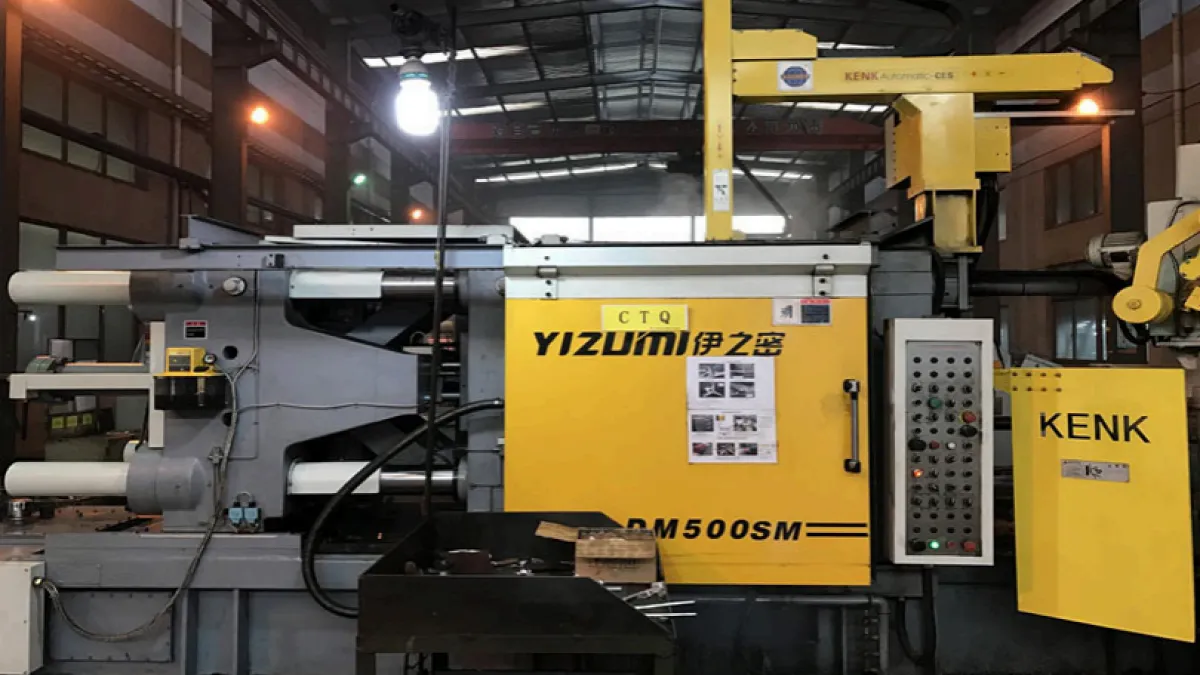
Zamak 5 casts on hot-chamber machines with the same short cycles as Zamak 3, often several hundred shots per hour on small multi-cavity dies. Its fluidity is marginally lower than Zamak 3, which is the most fluid of the family, but the difference is small in practice: walls down to about 0.5 mm and crisp detail remain achievable on well-gated tools. Die life is a major economic advantage of the grade, routinely exceeding one million shots because zinc is gentle on tool steel at hot-chamber temperatures.
Dimensional capability matches Zamak 3 in the as-cast state, with tolerances around ±0.05 mm achievable on small features, so most parts ship net-shape with no machining. Where machining is needed, Zamak 5 cuts cleanly and its higher hardness gives slightly better thread engagement and wear on machined features.
Corrosion Resistance and Surface Finishing
Like all Zamak grades, Zamak 5 forms a protective oxide film and handles normal indoor atmospheres without a coating. For appearance parts or harsher environments, it accepts the full finishing range: copper-nickel-chrome electroplating, mirror polishing before plate, powder coating, wet paint, and chromate or trivalent passivation. Plated Zamak 5 hardware passes standard salt-spray requirements when the plating stack is specified correctly. The copper content can shift chromate film color slightly compared with Zamak 3, so if color-critical passivated parts run in both grades, approve samples from each.
Equivalent Grades and International Designations
Zamak 5 appears under several designations depending on region and standard. They describe the same alloy.
| Standard / System | Designation |
|---|---|
| ASTM B86 | AC41A |
| UNS | Z35531 |
| EN 12844 | ZP0410 (ZnAl4Cu1) |
| JIS H5301 | ZDC1 |
| Common names | Zinc Alloy 5, Alloy 5, Mazak 5, ZL5 / ZL0410 |
Typical Applications
Zamak 5 shows up wherever a zinc casting carries real load. Common examples by sector:
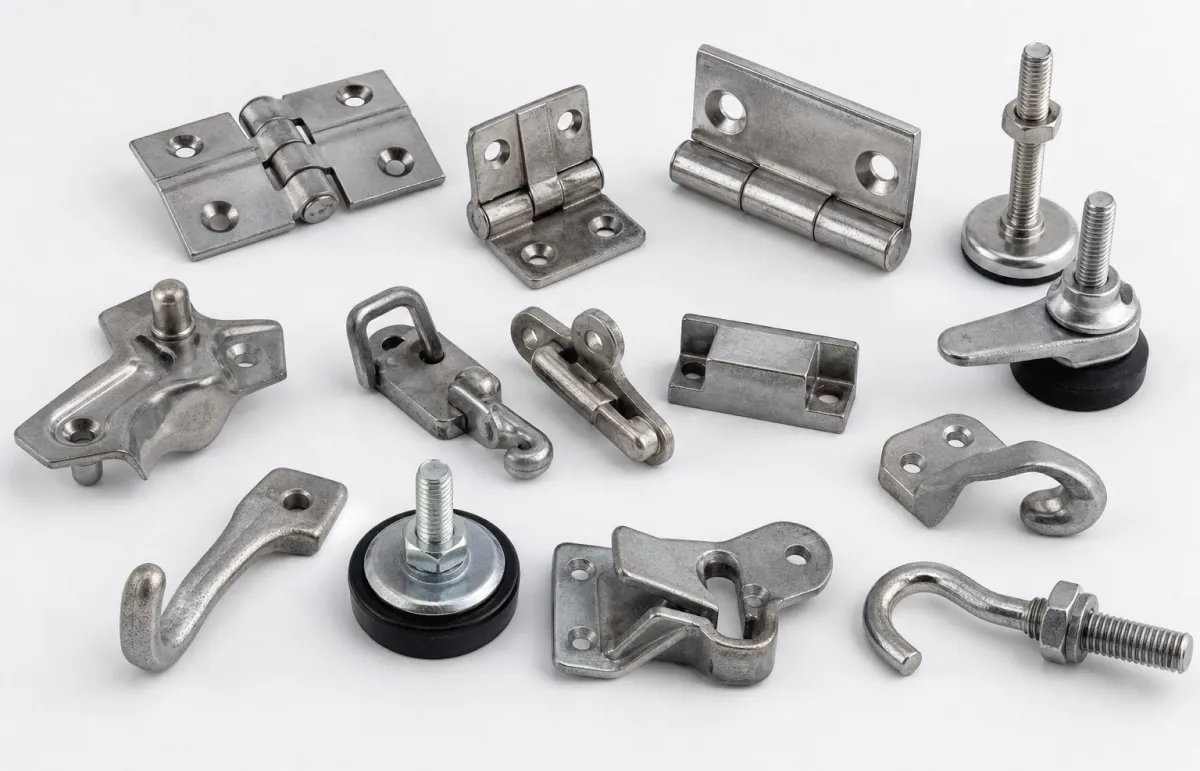
Appliance hardware: refrigerator door hinges, center and bottom hinges, door hooks, and levelling feet, where the part supports door weight or cabinet load through years of cycles. These are exactly the parts where hinge pin holes must stay round and clamped joints must stay tight.
Automotive: seat-belt mechanism parts, window regulator components, brackets, pulleys, and interior mechanism levers that see repeated mechanical load.
Industrial and mechanical: small gears, gear housings, latches, lock bodies, tool components, and wear parts in sliding contact.
Electrical: connector bodies and housings under clamping force, switchgear components, and meter parts.
Fittings and hardware: load-rated furniture fittings, door closer parts, and adjustable feet that carry a ton or more of static load in assembled products.
When Zamak 3 Is Still the Better Choice
Zamak 5 is not an automatic upgrade. Choose Zamak 3 when the part is decorative or lightly loaded, when a secondary forming operation needs the extra ductility, when long-term dimensional stability governs, as in gauge bodies and precision housings, or when cost per kilogram must be the lowest possible. Since both grades run on the same machines and dies, switching between them later is a material change, not a retooling project, which keeps the decision low-risk if requirements evolve.
Specify Zamak 5 with Confidence
Getting reliable Zamak 5 parts depends on control around the alloy: verified ingot chemistry, stable melt and die temperatures, sound gating, and a finishing line matched to the spec. At Meituo, we run hot-chamber zinc die casting in-house in both Zamak 3 and Zamak 5, verify every incoming lot by spectrometer, and produce plated appliance hardware, hinges, hooks, nuts, and levelling feet for OEM programs worldwide. Send us your drawing and load case, and our engineering team will confirm the right grade, return a DFM review, and quote tooling and part price together.